
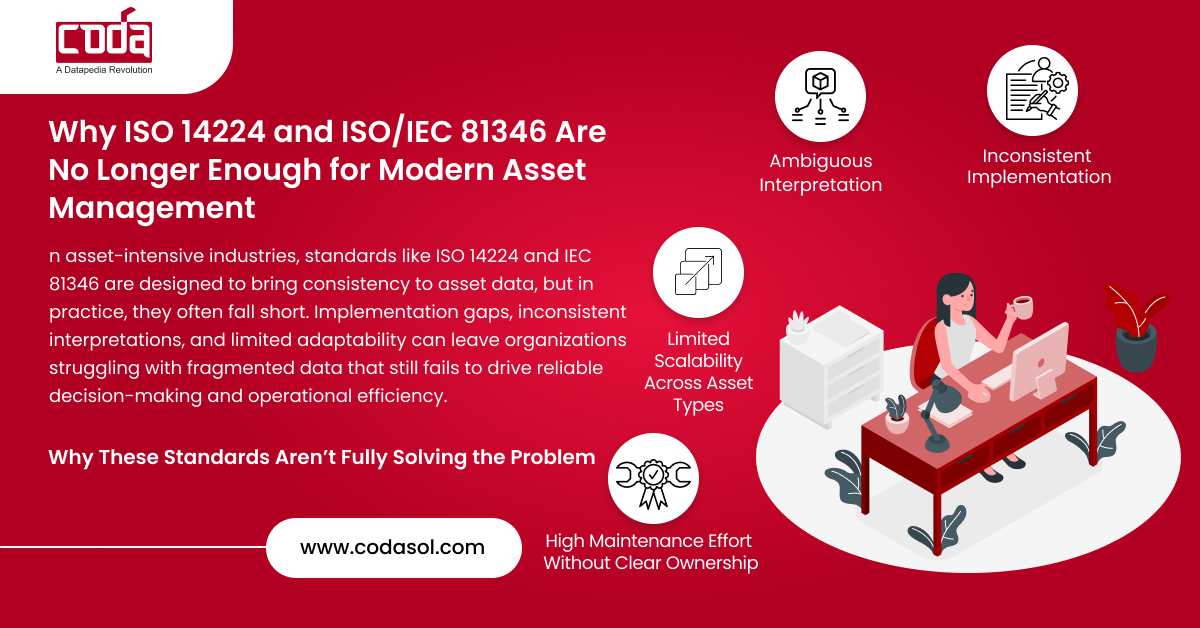
Why ISO 14224 and ISO/IEC 81346 Are No Longer Enough for Modern Asset Management
Modern asset-intensive enterprises are sitting on more data than ever before. But here’s the friction point decision-makers feel every day: despite adopting global asset data standards like ISO 14224 and ISO/IEC 81346, their operations still suffer from inconsistent hierarchies, unreliable asset information, poor visibility, and limited analytics.
Industrial operations today run on real-time sensors, digital twins, interconnected EAM/CMMS systems, and cross-site data flows that the original standards were never designed to handle. When the business expects predictive insights, unified master data, and AI-ready structures, relying solely on these legacy standards creates a structural ceiling.
This article breaks down why ISO 14224 and ISO/IEC 81346 fall short, what modern enterprises need instead, and how forward-looking organizations across India, GCC, Far East, the UK, and the US are closing the gap.
What ISO 14224 and ISO/IEC 81346 Were Designed to Do
Before exploring the limitations, it’s important to acknowledge their strengths. These standards did not fail. The world simply outgrew them.
ISO 14224: Reliability and Maintenance Data
ISO 14224 governs how organizations collect and structure failure, maintenance, and reliability data.
It provides:
- Failure mode and cause coding
- Maintenance activity structures
- Standardized equipment classes
- Clear reliability indicators
- Benchmarking capability across locations
It was a breakthrough for oil & gas, energy, utilities, and heavy manufacturing industries, where reliability is non-negotiable.
ISO/IEC 81346: Asset Structuring and Classification
ISO/IEC 81346 focuses on asset hierarchy and unique identification.
It defines how you label and classify assets within large systems.
It helps enterprises:
- Define functional locations
- Structure complex technical systems
- Maintain consistent naming conventions
- Reduce ambiguity across engineering and operations
Together, they bring order, clarity, and consistency to asset management.

Your asset data may be ISO-compliant, but is it digital-ready? Get a complete assessment of your asset data maturity across structure, governance, metadata, and digital readiness.
Modern Asset Management Has Evolved Beyond Static Standards
Today’s industrial operations run on a dynamic asset data universe, not just static maintenance codes or classification structures.
Across ports, refineries, process plants, utilities, EPCs, and manufacturing units, decision-makers need:
- Real-time visibility
- Cross-system interoperability
- Predictive insights
- Data governance
- AI-ready structures
- Digital-twin-friendly metadata
- End-to-end lifecycle traceability
ISO 14224 and 81346 were never built for these capabilities.
Where Traditional Asset Data Standards Fall Short
They were not designed for real-time or IoT-generated data
Industrial environments now produce continuous streams of sensor data, temperature, vibration, flow, load, and environmental parameters. These time-series data streams power:
- Condition monitoring
- Predictive maintenance
- Digital twins
- Real-time dashboards
- Optimization models
But ISO 14224 and 81346 only address static or event-based data.
They provide no framework for:
- Streaming data
- IoT device metadata
- Sensor calibration parameters
- Connected asset states
- Continuous condition data
This leaves enterprises stitching together fragmented datasets with no unified structure.
They do not cover contextual or extended metadata
Modern asset decisions require more than a class code or failure mode. They require context.
Today’s metadata needs include:
- Duty cycle
- Operating conditions
- Environmental parameters
- Vendor specifications
- Asset genealogy
- Spare part lineage
- Modification history
- Compliance attributes
None of this is defined in the earlier standards. When context is missing, AI models become inaccurate, analytics remain shallow, and decision-making becomes reactive instead of strategic.
They fail at enterprise-scale governance and data integrity
Large organizations operate:
- Across multiple regions
- With multiple ERPs
- With multiple EAM/CMMS systems
- With multiple engineering contractors
- With multiple data owners
Without modern governance, ISO-based structures degrade rapidly.
You get:
- Duplicate asset codes
- Broken hierarchies
- Inconsistent naming
- Localized conventions
- Missing classification attributes
- Non-standard spare parts mapping
This is the single biggest reason executives see “unreliable asset data” even after implementing standards.
They are not designed for lifecycle intelligence
Modern enterprises expect asset intelligence across the entire lifecycle:
- Procurement
- Installation
- Commissioning
- Operation
- Maintenance
- Overhauls
- Decommissioning
But ISO 14224 and 81346 only cover slices of this timeline. Digital twins, predictive models, lifecycle costing, and enterprise analytics all require far richer, continuous data structures that these standards don’t define.
They create silos when used without modern platforms
Without a unified master data layer, ISO-structured data typically gets trapped inside:
- SAP PM
- Oracle EAM
- Maximo
- Engineering databases
- Spreadsheets
- Contractor submissions
This prevents cross-plant visibility and data-driven decisions.
Asset-intensive enterprises lose:
- Spend optimization
- Spare-parts rationalization
- Cross-site benchmarking
- Predictive insights
- Enterprise-wide reliability studies
The standards were never meant to solve these problems, modern MDM platforms are.
What Modern Asset Management Actually Needs
Here’s the modern enterprise playbook that leading manufacturers, refineries, utilities, and EPC firms are adopting worldwide.
Unified asset definition with extended metadata
A future-ready asset dataset includes:
- Standardized hierarchy
- Maintenance history
- Sensor data
- Specification sheets
- Engineering drawings
- Environmental context
- Risk attributes
- Regulatory tags
- Spare-parts relationships
- Asset genealogy
This holistic profile becomes the backbone for AI and operational intelligence.
Real-time data integration and time-series support
Next-gen systems must natively support:
- IoT device metadata
- Continuous streaming data
- Digital twins
- Sensor-based anomaly detection
- Real-time dashboards
ISO 14224 and 81346 simply weren’t designed for this. Platforms like CODA integrate IoT, drone capture, and 3D simulations into a unified data layer, giving enterprises the real-time visibility the older standards were never designed for.
Strong governance and quality controls
Data governance is no longer optional.
Successful organizations enforce:
- Master data ownership
- Version control
- Validation and deduplication
- Golden record creation
- Automated enrichment
- Change management
- Cross-system synchronization
This prevents asset data decay and keeps the enterprise future-ready. Infony offers automated quality scoring, health checks, and enrichment pipelines so asset hierarchies remain consistent across SAP, Oracle, Maximo, and engineering systems.
Built-in readiness for AI, ML, and predictive analytics
Predictive maintenance is only possible when data is:
- Clean
- Connected
- Complete
- Contextual
- Governed
Standards get you 10% of the way. Platforms do the remaining 90%.
Modern platforms such as PROSOL and ProPedia are already designed with extended metadata models, governance workflows, and AI-powered enrichment, helping enterprises close this gap without restructuring their entire EAM ecosystem.
Legacy Standards vs Modern Asset Data Approach
| Capability | ISO 14224 / ISO/IEC 81346 | Modern Asset Data Approach |
|---|---|---|
| Asset classification | Yes | Yes |
| Reliability data | Yes | Yes + enriched detail |
| Real-time data support | No | Yes |
| IoT integration | No | Yes |
| Digital twin readiness | No | Yes |
| Governance & quality control | Minimal | Robust, automated |
| Enterprise-wide visibility | Limited | Unified |
| AI & predictive analytics | Not supported | Fully supported |
| Spare-parts genealogy | No | Yes |
| Lifecycle intelligence | Limited | End-to-end |
What This Means for Decision-Makers
If you’re evaluating asset data readiness, the key takeaway is clear: ISO-based structures are necessary but not sufficient. Leading organizations now use standards as the starting point, then build a modernized, extensible, governed data model on top. This is exactly where modern MDM platforms, digital twin systems, and unified data governance solutions play a critical role.
If your enterprise is moving toward predictive maintenance, digital twins, or enterprise-wide reliability programs, you need more than standards, you need a real asset data backbone.

Frequently Asked Questions
1. Is ISO 14224 still relevant?
Yes. It provides a strong foundation for maintenance and reliability data. But it cannot support IoT, predictive analytics, or digital twins without additional data structures.
2. Does ISO/IEC 81346 support real-time monitoring?
No. It is designed for classification and naming conventions, not continuous data streams.
3. Do I need a modern MDM platform if I follow these standards?
Yes. Standards define structure. The platform ensures accuracy, governance, integration, and scalability.
4. Can a modern platform coexist with ISO standards?
Absolutely. Modern platforms build upon ISO standards and extend them to meet digital-era requirements.
5. Which industries benefit most from modern asset data approaches?
Oil & gas, utilities, manufacturing, EPC, ports, marine, healthcare, aviation, metals & mining, real estate, and government agencies.