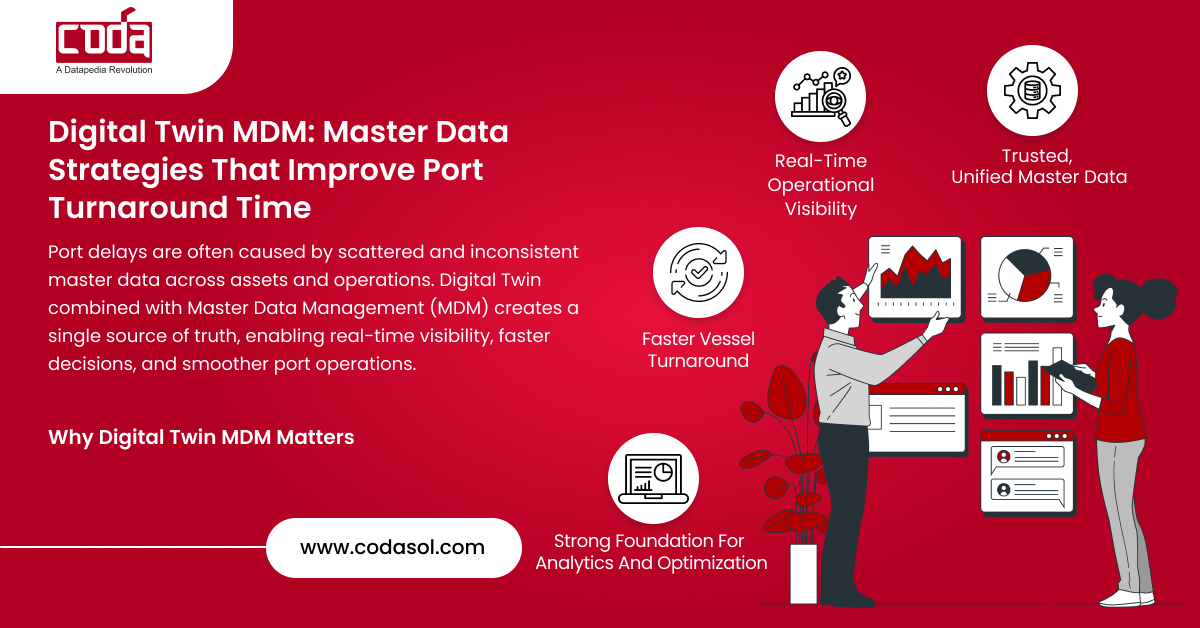
Digital Twin MDM: Master Data Strategies That Improve Port Turnaround Time
Ports and marine terminals lose millions each year to slow vessel turnaround, idle equipment, and poor coordination between systems. In most cases, the root cause is not technology gaps but unreliable master data feeding Digital Twin MDM initiatives that are expected to support real-time operations.
Digital twins promise visibility and operational control. However, without governed Master Data Management (MDM), those insights remain unreliable. Together, Digital Twin MDM provides ports with a practical foundation for faster turnaround, predictable performance, and measurable return on investment.
This article explains how digital twins and master data work together, why ports are investing now, and how platforms like PROSOL enable this transformation at scale.
What Digital Twin MDM Means for Ports and Marine Operations
A digital twin is a real-time virtual model of physical port operations. It mirrors vessels, berths, cranes, yards, warehouses, and supporting infrastructure. Decision-makers use it to simulate scenarios, predict bottlenecks, and optimize resources before problems occur.
Master Data Management provides the foundation. It ensures that critical entities such as:
- Vessels
- Equipment
- Berths
- Materials and spare parts
- Vendors and service providers
are defined once and used consistently across ERP, EAM, TOS, and analytics platforms.
Digital Twin MDM connects these two capabilities. The digital twin relies on accurate master data to produce reliable insights. Without MDM, simulations are based on inconsistent or incomplete records, leading to wrong decisions at the operational level.
Why Port Turnaround Time Depends on Data Quality
Turnaround time is influenced by hundreds of micro-decisions every day. These decisions depend on data coming from multiple systems that often do not agree with each other.
Common data challenges in ports include:
- Duplicate equipment and asset records across SAP and terminal systems
- Inconsistent material descriptions for spares and consumables
- Missing maintenance attributes for cranes and critical assets
- Disconnected vendor and contractor master data
When this data feeds a digital twin, the model reflects uncertainty instead of clarity. With a governed master data layer in place, the digital twin operates on a single source of truth. That is when predictive insights turn into operational improvements.

Struggling with duplicate asset records, inconsistent SAP data, or unreliable digital twin outputs?
How Digital Twin MDM Improves Turnaround Performance
When digital twin models are powered by trusted master data, ports gain measurable improvements across core KPIs.
| Operational Area | Without Digital Twin MDM | With Digital Twin MDM |
|---|---|---|
| Vessel turnaround | Reactive scheduling | Predictive berth allocation |
| Equipment uptime | Break-fix maintenance | Condition-based maintenance |
| Yard congestion | Manual adjustments | Real-time simulation |
| Data accuracy | High reconciliation effort | Single source of truth |
| Decision speed | Delayed | Near real-time |
1. Predictive Maintenance for Critical Port Assets
In ports, digital twins continuously track the condition of critical assets such as quay cranes, RTGs, and ship-to-shore cranes by combining real-time sensor data with historical maintenance records from ERP and EAM systems.
However, these insights are only reliable when asset data is consistent. Therefore, master data management ensures assets are uniquely identified and correctly linked to equipment hierarchies, specifications, failure modes, and spare parts. As a result, digital twins can detect early signs of degradation and support condition-based maintenance.
Consequently, ports benefit from
- Fewer unplanned equipment failures
- Optimized maintenance windows aligned with vessel schedules
- Reduced emergency work orders and downtime
Ultimately, better asset data leads to faster vessel turnaround.
2. Optimized Berth and Yard Planning
Similarly, berth and yard planning relies on accurate master data for vessels, cargo, equipment, and operational constraints. When this data is governed centrally, digital twins can simulate real-world conditions and test multiple planning scenarios in advance.
For instance, planners can quickly adjust berth allocation and crane deployment when arrival times change. As a result, ports reduce idle time while improving utilization and responsiveness.
In short, trusted master data enables more reliable and efficient planning.
3. Reduced Manual Coordination Across Systems
At the same time, port operations span multiple systems and stakeholders. Without shared master data, teams must manually reconcile information across platforms.
To prevent this, MDM synchronizes reference data across systems and provides consistent identifiers. Consequently, digital twins become a shared operational view, reducing emails, spreadsheets, and handoffs.
Therefore, ports achieve faster decisions, fewer errors, and smoother coordination across operations.
How PROSOL Enables Digital Twin MDM for Ports
PROSOL is an AI-driven master data management platform designed for asset-intensive industries, including ports and marine terminals.
1. Centralized Master Data Repository
PROSOL creates a single source of truth for:
- Equipment and asset master
- Material and spare parts master
- Vendor and service provider master
This ensures digital twins consume consistent data across systems.
2. AI-Driven Data Cleansing and Enrichment
Ports often deal with legacy data accumulated over decades. PROSOL uses AI and ML to:
- Detect duplicates
- Standardize descriptions
- Enrich missing attributes
This dramatically improves the accuracy of digital twin simulations.
3. Built-in Data Governance
PROSOL enforces built-in data governance rules that prevent poor-quality or inconsistent master data from entering operational systems. These controls standardize how asset, material, and vendor data is created, reviewed, approved, and updated across the organization.
By embedding validation checks, approval workflows, and role-based access controls, PROSOL ensures that only accurate, complete, and compliant data flows into ERP, EAM, and digital twin platforms. As a result, digital twins operate on trusted data rather than assumptions.
Digital Twin MDM at Speed: How PROSOL Swift Enables Port Operations
Ports cannot afford long MDM implementation cycles. PROSOL Swift, our specially designed data cleansing tool, will deliver rapid value without disrupting operations.
Key PROSOL Swift Capabilities
- Accelerated data onboarding for materials, assets, and vendors
- Pre-configured industry templates for faster standardization
- Automated workflows that reduce manual effort
- Quick integration with existing ERP landscapes
It allows ports to start small, prove value, and scale digital twin initiatives without long transformation timelines.
SAP Integration: Enabling Digital Twin MDM at Enterprise Scale
Many ports use SAP for finance, materials management, maintenance, and asset management. PROSOL integrates seamlessly with SAP environments and offers you effective benefits
- Native integration with SAP ECC and S/4HANA
- Synchronization of material, asset, and vendor masters
- Clean data flowing into SAP EAM, MM, and PM modules
- Consistent data feeding analytics and digital twin platforms
With PROSOL acting as the master data backbone, SAP becomes a reliable execution system rather than a data correction engine.
Real-World Impact: What Ports Can Expect
Based on industry benchmarks and practical deployments, ports adopting Digital Twin MDM can expect:
- 20–35% reduction in unplanned equipment downtime
- 15–30% improvement in vessel turnaround time
- Significant reduction in duplicate spare parts inventory
- Faster planning cycles with fewer manual interventions
A hypothetical example:
A mid-size container terminal using Digital Twin MDM reduced crane downtime by 28% within six months by combining predictive maintenance with standardized asset master data.
Final Thoughts: Digital Twin Success Starts with Data
Digital twins do not fail because of technology. They fail because of unreliable data. Ports that treat master data as a strategic asset unlock the full value of simulation, prediction, and optimization.
With platforms like PROSOL and PROSOL Swift, ports can establish a governed master data foundation that integrates seamlessly with SAP and powers digital twins with confidence.
The result is faster turnaround, lower risk, and smarter operations.

See how PROSOL enables Digital Twin MDM for ports and marine enterprises.
Frequently Asked Questions
1. Why is master data critical for digital twins in ports?
Digital twins rely on accurate asset, vessel, and material data. Poor master data leads to unreliable simulations and wrong decisions.
2. Can PROSOL work with existing SAP systems?
Yes. PROSOL integrates with SAP ECC and S/4HANA, ensuring clean data flows into EAM, MM, and PM modules.
3. How fast can ports see value from PROSOL Swift?
Many organizations see measurable improvements within weeks, not months, due to accelerated onboarding and automation.
4. Is Digital Twin MDM only for large ports?
No. Mid-size terminals benefit significantly, especially when scaling operations or modernizing legacy systems.
Ready to improve port turnaround time with trusted data, SAP-ready governance, and scalable digital twin integration?