
Master Data Migration: Oracle EBS → Oracle
EAM / Maximo Rollout Guide
Master data migration is the foundation of every successful Oracle EBS → Oracle EAM or Maximo rollout. Enterprise EAM rollouts fail more often due to poor master data than due to software limitations. If your Oracle EBS data is inconsistent, duplicated, or incomplete, moving to Oracle EAM or IBM Maximo will only amplify those problems, not solve them.
This guide explains how to migrate master data the right way during an Oracle EBS → Oracle EAM or Maximo rollout, with a practical framework built for asset-intensive enterprises in oil & gas, utilities, manufacturing, EPC, and regulated industries.
What Is Master Data Migration?
Master data migration is the process of moving critical business data, assets, materials, BOMs, vendors, and maintenance records from one system to another while ensuring it is accurate, consistent, and ready for use. In an Oracle EBS → Oracle EAM or Maximo rollout, it guarantees the EAM system starts with a trusted, complete dataset.
In an Oracle EBS → Oracle EAM or Maximo rollout, it:
- Cleans and standardizes data
- Maps records to the new system
- Maintains governance before and after go-live
Using platforms like PROSOL ensures a golden record, prevents duplicates, and supports a smooth, reliable EAM rollout.
Why Master Data Migration Determines EAM Rollout Success
Oracle EAM and IBM Maximo depend on trusted master data to drive maintenance planning, spare parts optimization, compliance, and asset reliability. When master data is weak, EAM systems struggle to deliver value.
Common consequences include:
- Duplicate asset records causing incorrect maintenance history
- Inconsistent material masters inflating MRO inventory
- Broken BOM relationships increasing downtime
- Poor visibility across plants and locations
- Audit failures in regulated environments
Master data migration is not a technical step. It is a business risk decision.
What Master Data Should Be Migrated (And What Should Not)
One of the biggest mistakes enterprises make is migrating everything from Oracle EBS. Successful rollouts migrate only business-critical, validated master data.
Core Master Data to Migrate
- Asset Master (equipment, functional locations, hierarchies)
- Material & MRO Master (critical spares, specifications, attributes)
- Bills of Materials (BOMs) linked to assets
- Vendors & Manufacturers
- Maintenance Task Lists/Plans (where applicable)
Data That Should Be Reassessed
- Obsolete materials
- Inactive vendors
- Assets with no maintenance history
- Custom legacy fields with no business owner
Selective migration reduces complexity, cost, and post-go-live issues.
Business Impact of Poor vs Governed Master Data
| Data Area | Poor Migration Outcome | Business Impact |
|---|---|---|
| Asset Master | Duplicate assets | Maintenance errors |
| Material Master | Wrong specs | Excess inventory |
| BOMs | Missing links | Unplanned downtime |
| Vendors | Inconsistent records | Procurement delays |
| Task Lists | Inaccurate steps | Safety & compliance risks |
A 5-Phase Framework for Master Data Migration
This framework reflects how successful Oracle EAM and Maximo rollouts are executed in asset-intensive enterprises.
Phase 1: Data Discovery & Risk Assessment
Start by understanding the true state of your Oracle EBS data:
- Identify duplicates and inconsistencies
- Assess attribute completeness
- Flag non-compliant records
- Prioritize critical assets and materials
Industries like Oil & Gas, Utilities, and Healthcare often discover that 30–40% of records are unusable without remediation.
Phase 2: Data Standardization & Cleansing
Before migration, data must be standardized:
- Naming conventions
- Units of measure
- Attribute formats
- Industry and ISO standards alignment
This step ensures Oracle EAM or Maximo receives usable, governed data, not legacy noise.
Phase 3: Oracle EBS → EAM / Maximo Data Mapping
This is where most technical failures occur. Key activities include:
- Field-to-field mapping between Oracle EBS and target EAM schemas
- Handling custom objects and extensions
- Preserving relationships (asset–BOM–material)
- Validating mandatory fields
Poor mapping leads to broken asset hierarchies and unusable maintenance plans.
Phase 4: Validation, Governance & Ownership
Migration without data governance is a temporary success.
Strong programs include:
- Business validation, not just technical checks
- Approval workflows
- Data stewards and business owners
- Audit trails for regulated industries
Governance ensures data quality after go-live, not just during migration.
Phase 5: Controlled Load & Post-Migration Monitoring
Successful rollouts use:
- Trial migrations
- Reconciliation reports
- Post-go-live monitoring
- Continuous data quality checks
This prevents slow degradation of master data over time.

Struggling with inconsistent asset or material data before your EAM rollout?
Common Enterprise Mistakes (And How to Avoid Them)
- Lift-and-shift migration without cleansing
- Treating master data as an IT-only responsibility
- No governance model post-go-live
- Ignoring industry compliance requirements
- No single source of truth for assets and materials
Each of these leads to delayed benefits and rising operational costs.
Why an MDM Platform Is Critical Before an Oracle EAM or Maximo Rollout
Data migration tools move data from Oracle EBS into Oracle EAM or Maximo. They do not control data quality, enforce standards, or stop bad data from returning after go-live. This is the gap where many EAM rollouts lose value.
An MDM platform governs master data across its full lifecycle, before migration, during rollout, and after the system is live.
For asset-intensive enterprises, master data constantly changes:
- New assets are added
- Spare parts evolve
- Vendors and specifications change
- Compliance requirements tighten
Without governance, even a clean migration degrades quickly.
What an MDM Platform Delivers
A structured MDM platform helps enterprises:
- Create a single source of truth for asset, material, BOM, and vendor master data
- Apply standard naming conventions and attribute rules across systems
- Enforce data validation before records enter Oracle EAM or Maximo
- Maintain data quality after migration, not just at go-live
- Support audits, traceability, and regulatory compliance
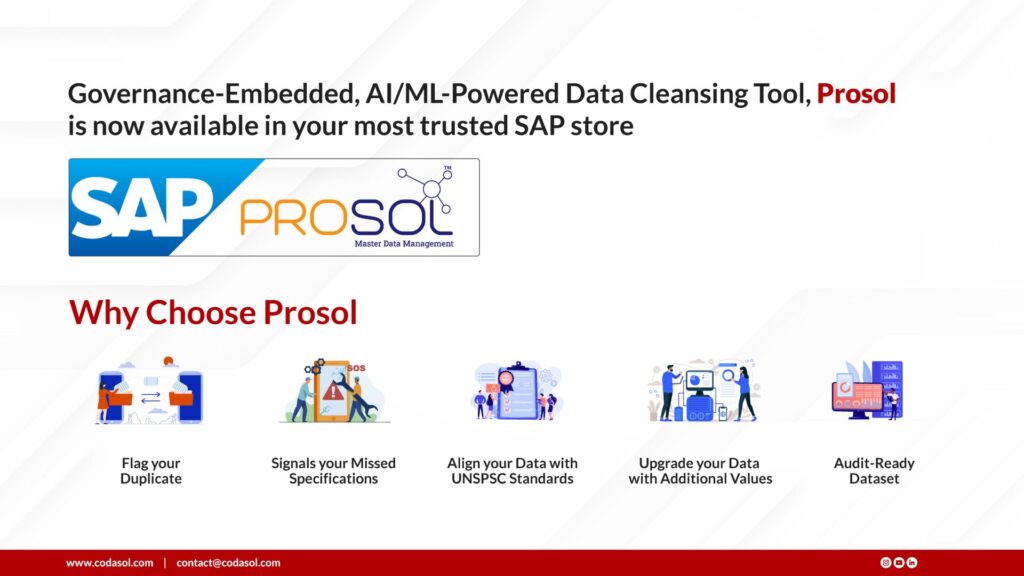
This is where PROSOL adds value. It is designed specifically for industrial master data management, with strong capabilities in data cleansing, enrichment, classification, and governance.
During an Oracle EBS → Oracle EAM or Maximo rollout, PROSOL ensures that master data is accurate, standardized, and ready for operational use:
- Clean and validated master data before migration
- A governed golden record after go-live
- Prevention of duplicates and non-compliant records
Seamless ERP and EAM Integration
Enterprises often run SAP ECC or SAP S/4HANA alongside Oracle EAM or Maximo. PROSOL, available on the SAP Store, enables consistent master data governance across ERP and EAM systems.
This integration provides:
- Unified material and vendor master data across platforms
- Smooth data flow between ERP and EAM
- Elimination of data fragmentation across business units
For large, regulated, or multi-plant enterprises, MDM is not optional; it is a critical risk-control layer that safeguards the long-term value of your EAM investment.
How to Choose the Right Master Data Migration Partner
A master data migration partner does more than move records. The right partner protects business continuity, compliance, and system adoption.
Decision-makers should evaluate partners using clear, practical criteria.
Industry-Proven Experience
Look for experience in asset-heavy environments such as Oil & Gas, Utilities, Manufacturing, EPC, Healthcare, Defense, and Aviation where data errors have real operational impact.
Strong Oracle and Maximo Expertise
Your partner must understand:
- Oracle EBS master data structures
- Oracle EAM and IBM Maximo data models
- Asset hierarchies, BOMs, and MRO relationships
Without this depth, migrations look successful but fail in daily operations.
Governance-First Delivery Approach
Effective partners embed governance from day one through:
- Data standards
- Stewardship models
- Validation and approval workflows
Governance should continue after go-live.
Post-Go-Live Data Sustainability
Migration success is measured over time. Partners should support:
- Ongoing data quality monitoring
- Controlled change management
- Long-term master data governance
Compliance and Audit Readiness
In regulated industries, partners must ensure:
- Traceable data changes
- Audit-ready master records
- Alignment with regulatory and internal standards
The right master data migration partner reduces technical risk, operational disruption, and long-term data debt, enabling Oracle EAM or Maximo to deliver measurable business outcomes.

Planning an Oracle EAM or Maximo rollout? Don’t let master data be the blind spot.
Frequently Asked Questions
1. How long does master data migration take?
Typically 8–16 weeks, depending on data volume and quality.
2.Can we migrate without MDM?
Yes, but data quality often degrades quickly after go-live.
3. What causes EAM rollouts to fail?
Poor master data quality, lack of governance, and weak ownership.
4. Which industries benefit most from structured migration?
Oil & Gas, Utilities, Manufacturing, EPC, Healthcare, Defense, and Aviation.
5. How do we maintain data quality after go-live?
Through governance workflows, stewardship, and continuous monitoring.
Final Words
Master data migration is the foundation of a successful Oracle EBS → Oracle EAM or Maximo rollout. When your data is clean, standardized, and properly governed, you reduce downtime, improve maintenance efficiency, optimize spare parts management, and maintain compliance across all plants and operations.
Take the first step toward a smooth, reliable, and compliant rollout. Reach out to our experts and see how PROSOL can transform your master data strategy.