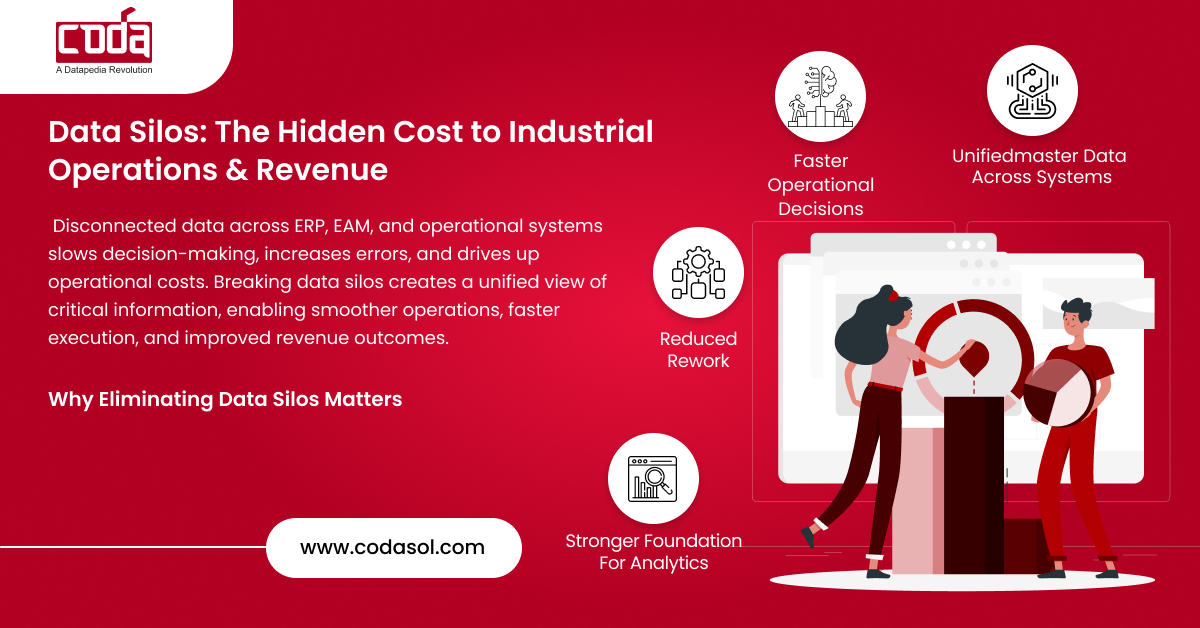
Data silos quietly undermine operations, compliance, and revenue growth in industrial enterprises.
How Data Silos Hurt Operations and Revenue in Oil, Manufacturing & Pharma
Data silos are one of the most significant challenges facing industrial enterprises today. In Oil & Gas, Manufacturing, and Pharma, fragmented information across ERP, EAM, and operational systems quietly slows operations, increases compliance risk, and erodes revenue growth.
Recent industry research confirms a simple truth: organizations that cannot unify their data are operating with a hidden handicap. For decision-makers, understanding the impact of data silos and knowing how to eliminate them is no longer optional.
This article explains what data silos are, how they affect operations and revenue, and how leading enterprises are tackling them using governed master data approaches.
What Are Data Silos in Industrial Enterprises?
Data silos exist when the same business information lives in multiple systems but is not shared or aligned. Each department may work with its own version of the truth, often without knowing which data is correct.
In Oil & Gas, Manufacturing, and Pharma, data silos often appear in:
ERP systems such as SAP, Oracle, or JD Edwards
Enterprise Asset Management (EAM) platforms
Inventory and spare parts databases
Engineering, procurement, and maintenance tools
Quality, compliance, and regulatory systems
For example, a single spare part might exist in multiple formats across plants or systems, each with different codes, descriptions, or classifications. This creates confusion, delays, and errors.
At this point, many organizations assume their ERP system will automatically fix the problem. But here’s why that rarely happens…
Want to make your ERP and EAM systems work together with Codasol Data Migration?
ERP systems manage transactions well but struggle with master data quality. This is why many organizations invest in material master cleansing and standardization before they see real operational improvement. Even after ERP deployment, data silos persist.
Why Data Silos Keep Happening
Multiple ERP Instances Across Plants or Regions Each plant or region may have its own ERP instance. Critical data like materials, assets, and vendors exist in multiple versions, creating fragmentation.
Mergers, Acquisitions, and Partnerships Integrating legacy ERP data after mergers or joint ventures is challenging. Without a unified approach, duplicates and inconsistencies multiply.
Local Data Creation and Customization Teams often create local records to meet immediate operational needs. While practical short-term, this generates inconsistent master data across the enterprise.
Lack of Standardized Master Data Definitions Without clear naming conventions, classification rules, or asset hierarchies, the same item or asset can exist in multiple formats, confusing people and systems.
No Enterprise-Wide Data Ownership Even with ERP systems, if no one “owns” the data across the organization, errors go unchecked, and departments govern their own silos.
How Data Silos Quietly Disrupt Operations
Once we understand why ERP systems can’t fix data silos, the operational impact becomes clear. Fragmented or duplicate data doesn’t just cause confusion; it directly affects productivity, costs, and revenue.
When assets, materials, or vendor information exist in multiple unaligned versions, teams face inefficiencies that ripple across maintenance, inventory, production, and compliance.
Key Operational Impacts
Operational Area
What Happens with Data Silos
What Happens with Governed Data
Maintenance
Work orders delayed, reactive maintenance, unplanned downtime
Staff spends hours correcting data instead of executing tasks
Focus on operations, innovation, and strategic work
Why This Happens
Maintenance Delays – Incomplete asset information forces engineers to verify data manually, increasing downtime and operational risk.
Inventory Duplication – When material records are duplicated across plants or systems, companies either overstock or experience stockouts, both impacting revenue.
Planning Inefficiencies – Disconnected production, asset, and procurement data make scheduling slow and error-prone, leading to missed deadlines or lost capacity.
Manual Workload – Teams spend hours reconciling conflicting records, reducing time for critical operational tasks like process optimization or strategic planning.
Bottom line: Data silos quietly reduce operational efficiency, increase costs, and can directly affect revenue growth. Fixing them isn’t just IT, it’s a strategic business imperative.
Industry-Specific Impacts of Data Silos
Oil & Gas
In Oil & Gas, silos often exist between upstream, midstream, and downstream operations. Fragmented asset and maintenance data reduce visibility into equipment health and spare parts availability, increasing unplanned downtime and safety risks.
Codasol helps Oil & Gas operators standardize asset and spare-part data across SAP and EAM systems, improving maintenance planning and uptime.
Manufacturers face disconnected BOMs, materials, and vendor data. Inconsistent specifications cause quality deviations, production delays, and misaligned procurement.
PROSOL users in manufacturing standardize materials and reduce duplicates, enabling faster planning and lower inventory costs.
Pharma & Lifesciences
Pharma enterprises often have inconsistent product, batch, and compliance data, slowing audits, regulatory reporting, and recall processes.
Codasol’s governance-led approach ensures audit-ready master data for regulated environments, improving compliance and operational confidence.
From Oil & Gas to Pharma, PROSOL helps eliminate fragmented records and improve planning, inventory, and compliance.
How Leading Enterprises Are Solving Data Silos: A Step-by-Step Framework
Successful organizations no longer treat master data as a departmental task; they manage it as a shared business asset. The result: cleaner, unified data that drives operational efficiency, regulatory compliance, and revenue growth.
Here’s a practical, step-by-step framework enterprises follow to eliminate data silos:
Step 1: Discover – Map Your Critical Data
Objective: Identify where your critical data resides and which areas are siloed.
How It Works:
Conduct a data audit across ERP, EAM, inventory, procurement, and maintenance systems.
Identify duplicate records, conflicting codes, and inconsistent classifications.
Prioritize high-impact domains such as spare parts, assets, vendors, and product data.
Why It Matters: You can’t fix what you don’t know exists. By pinpointing the areas where data fragmentation is causing the most operational inefficiency, teams can target improvements for maximum ROI.
PROSOL Role: Automatically scans multiple systems, flags duplicates, inconsistencies, and gaps, giving decision-makers a single, visual map of siloed data.
Step 2: Clean – Deduplicate and Standardize Records
Objective: Ensure every critical data entity exists in a single, accurate, and standardized form.
How It Works:
Merge duplicate records and eliminate conflicting entries.
Apply consistent naming conventions, codes, units, and hierarchies across all systems.
Validate data against industry standards and regulatory requirements.
Why It Matters: Cleaning data reduces errors in maintenance, inventory, and production planning. For example, standardized spare-part codes prevent duplicate purchases and unnecessary downtime.
PROSOL Role: Uses AI-driven matching algorithms to identify duplicates and suggest standard formats, enabling teams to clean data quickly without manual reconciliation.
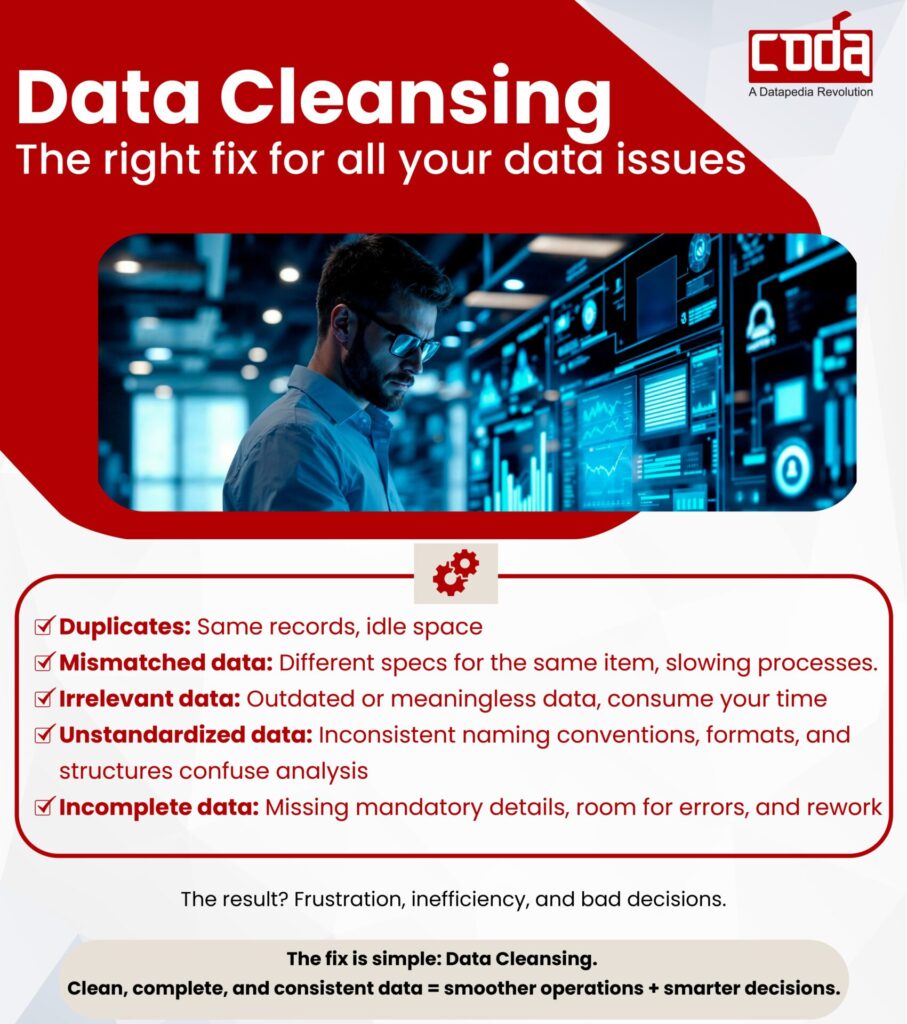
Data Cleansing
Step 3: Govern – Assign Ownership and Enforce Rules
Objective: Prevent future silos by embedding accountability and clear data standards.
How It Works:
Assign enterprise-level owners for each data domain (e.g., maintenance, inventory, vendor).
Define rules for data creation, modification, and approval, including standardized templates.
Implement workflows to ensure data changes are reviewed before adoption.
Why It Matters: Governance transforms master data from a “nice-to-have” to a business-critical asset. Teams no longer create rogue records, and changes are tracked and validated across the enterprise.
Objective: Ensure all ERP, EAM, and operational systems access the same master data in real time.
How It Works:
Synchronize standardized master data across multiple platforms.
Use APIs or data connectors to update records automatically across ERP, EAM, and inventory systems.
Ensure legacy systems and newly implemented platforms consume the same single source of truth.
Why It Matters: Integration eliminates the classic problem of each department maintaining its own version of the truth. This drives consistency across maintenance, procurement, production, and compliance processes.
PROSOL Role: Acts as a centralized master data hub, pushing standardized records to connected systems, preventing silos from reforming.
Step 5: Monitor – Continuously Measure and Improve Data Quality
Objective: Sustain data quality and prevent silos from reappearing over time.
How It Works:
Track data quality metrics like completeness, accuracy, duplication, and compliance.
Set up alerts for inconsistencies or anomalies in real time.
Periodically review data governance policies and workflows for relevance and effectiveness.
Why It Matters: Data quality is not a one-time fix. Continuous monitoring ensures your organization keeps operations running smoothly, reduces costs, and maximizes ROI.
PROSOL Role: Provides dashboards, automated alerts, and analytics to track improvements, highlight issues, and guide corrective actions, keeping master data clean and actionable.
Wrapping Up
Data silos quietly slow operations, increase costs, and reduce revenue in Oil & Gas, Manufacturing, and Pharma. Leading enterprises solve this by discovering, cleaning, governing, integrating, and monitoring master data, turning fragmented information into a single source of truth.
Codasol PROSOL makes this possible across ERP, EAM, and operational systems, improving maintenance, inventory, production planning, and compliance, while keeping data accurate and actionable.