

Material Master Data Lifecycle Challenges and How PROSOL Solves Them
Material master data powers operations in asset-intensive industries such as Oil & Gas, Utilities, Manufacturing, Aviation, EPC, Marine & Ports, and Healthcare. In regions like India, GCC, and the US, accurate material data ensures smooth procurement, optimized inventory, timely maintenance, and regulatory compliance. When inconsistencies creep in, such as duplicates, missing attributes, or misclassified materials, organizations face inventory bloat, delayed maintenance, and underperforming ERP systems, resulting in lost efficiency and revenue.
This article explores the technical pain points in the material master data lifecycle, their operational and financial impact, and how PROSOL’s control framework enforces governance, standardization, and automation to solve them.
Material Master Data and Its Lifecycle: The Foundation of Enterprise Operations
Material master data is the authoritative set of information defining every item, spare part, raw material, or consumable in an organization. It acts as the single source of truth for ERP, EAM, inventory, procurement, maintenance, and finance systems. Any inaccuracy, duplicates, missing attributes, or inconsistent descriptions directly impact attribute costs, operations, and reporting.
The material master data lifecycle governs how records are created, standardized, validated, approved, used, and retired. Proper lifecycle control ensures consistency, reliability, and operational efficiency, while poor control leads to duplicate materials, excess inventory, maintenance delays, and compliance risks. In asset-intensive enterprises, this lifecycle is foundational to operational performance, ERP effectiveness, and data-driven decision-making.
Why Material Master Data Is Needed in Asset-Intensive Enterprises
In asset-intensive industries, the material data directly support operational continuity. Maintenance teams rely on it to identify the right spare parts. Procurement depends on it to source materials efficiently. Finance and compliance teams use it for valuation, audits, and reporting.
When it is reliable:
- Maintenance downtime is reduced
- Inventory levels remain optimized
- Procurement cycles are predictable
- Compliance requirements are met
- ERP analytics become trustworthy
When it is not, organizations experience duplicate materials, excess stock, emergency purchases, delayed maintenance, and increased operational risk.
As enterprises scale across plants, regions, and systems, material master data must be controlled, standardized, and governed. This is why managing its lifecycle is no longer an option but a foundation to operational performance and ERP success.
Core Technical Challenges in the Material Master Data Lifecycle
The lifecycle challenges are fundamentally data quality and governance failures that quickly escalate into operational and financial risk when unchecked. Across asset‑intensive enterprises, several technical issues recur:
1. Duplicate and Inconsistent Records
What happens: The same material is created multiple times due to decentralized workflows or free-text entries.
Impact: Leads to overstocking, procurement errors, and inaccurate BOMs, slowing operations and increasing costs.
2. Weak Standardization and Classification
What happens: Materials are labeled inconsistently or lack proper classification frameworks.
Impact: Reduces searchability and procurement accuracy, leading to errors in BOMs and project delays.
3. Inadequate Governance & Approval Workflows
What happens: Material creation occurs via informal processes like emails or spreadsheets without proper validation.
Impact: Bad data enters ERP systems, creating costly corrections and operational delays.
4. Legacy Data and ERP Migration Risks
What happens: Outdated or inconsistent material records are migrated to new ERP systems (e.g., SAP S/4HANA) without cleansing.
Impact: Causes data chaos, loss of trust in systems, and increased post-go-live remediation costs.
5. Fragmented System Integration
What happens: ERP, EAM, inventory, and procurement systems operate in silos without real-time synchronization.
Impact: Leads to maintenance delays, procurement bottlenecks, and slower operational processes.
These challenges collectively create duplicate records, excess inventory, delayed maintenance, and compliance risks, emphasizing the need for a structured, automated material master data control framework.
Business Impact of Broken Material Master Data Lifecycle
Before moving to solutions, it’s important to understand how broken material master data affects core operations and revenue.
| Function | Without Lifecycle Control | With Controlled Lifecycle |
|---|---|---|
| Inventory | Overstocking, dead stock | Optimized spares |
| Maintenance | Wrong part usage | Accurate BOM mapping |
| Procurement | Emergency sourcing | Standardized buying |
| Compliance | Audit gaps | Full traceability |
| Analytics | Low confidence | Reliable insights |

Unify your master data and boost decision-making with a Golden Record for vendors, customers, and assets.
How to Keep Your Material Data Clean and Avoid Revenue Loss
Understanding these challenges’ impact on operations and revenue makes it clear why structured control is essential. The following checklist highlights the critical steps enterprises must take.
☐ Centralize Material Creation
Use a single workflow to prevent uncontrolled material requests.
☐ Enforce Standard Naming & Classification
Apply enterprise-wide conventions (ISO/UNSPSC) to avoid duplicates.
☐ Mandatory Attribute Completion
Complete all technical, procurement, and storage fields before activation.
☐ Role-Based Governance & Approval
Assign owners and enforce approvals with audit trails.
☐ Duplicate Detection & Prevention
Use automated or AI-assisted tools to flag duplicates.
☐ Regular Data Validation & Quality Audits
Periodically review inactive, misclassified, or erroneous materials.
☐ Lifecycle Status Management
Define Active, Blocked, and Obsolete statuses; retire outdated records.
☐ Integration & Synchronization Across Systems
Ensure ERP, EAM, procurement, and inventory systems share a single source of truth.
☐ Training & Change Management
Educate teams on standards and workflows for adoption.
Impact on Revenue:
Proper control minimizes overstock, emergency procurement, maintenance delays, and reporting errors, directly safeguarding revenue and operational efficiency.

Reduce your duplicates, streamline approvals, and safeguard revenue with PROSOL.
How PROSOL Solves Material Master Data Lifecycle Challenges
PROSOL enforces control across the material master data lifecycle by combining governance, standardization, and automation within a single framework.
Controlled Material Creation
PROSOL introduces guided material request workflows that:
- Eliminate free-text creation
- Enforce standardized naming conventions
- Capture mandatory technical attributes upfront
This prevents data quality issues at the point of entry.
Standardization and Classification at Scale
PROSOL applies:
- Rule-based description logic
- Industry-aligned classification structures
- Attribute completeness checks
This ensures consistency across plants, projects, and regions.
Embedded Governance and Approval Workflows
Governance is built into the system:
- Role-based approvals
- Segregation of duties
- Full audit trails
Material records are released only after meeting defined quality and compliance criteria.
Duplicate Detection and Prevention
PROSOL uses:
- Similarity matching
- Attribute-level comparison
- Automated duplicate alerts
Duplicates are identified before they enter ERP systems, not after.
Lifecycle Status and Obsolescence Control
PROSOL manages:
- Active, blocked, and obsolete statuses
- Controlled retirement of unused materials
- Reduced clutter in ERP databases
This keeps material master data relevant and usable
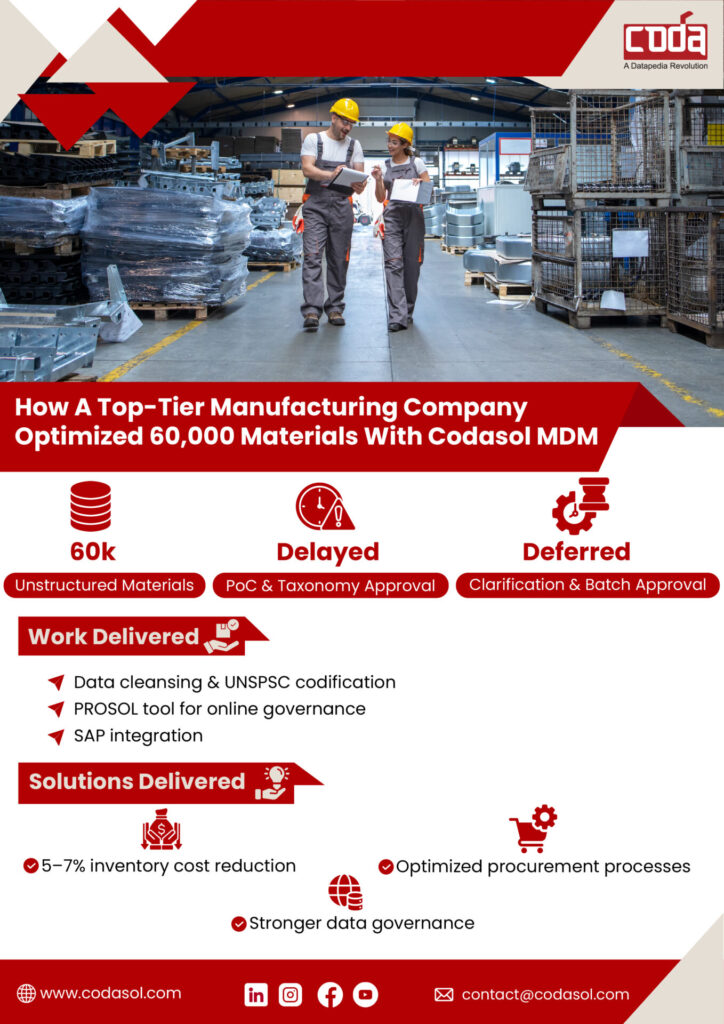
Final Wrap
Accurate material master data is critical for operational efficiency, compliance, and revenue protection. Unmanaged or inconsistent data leads to inventory inefficiencies, maintenance delays, and ERP underperformance.
PROSOL delivers a scalable, automated framework with guided workflows, approvals, duplicate prevention, and lifecycle management, ensuring your material data is consistent, reliable, and actionable.
Protect revenue, optimize operations, and simplify your compliance in material master data today.
Frequently Asked Questions
1. Why does material master data lifecycle control matter?
Uncontrolled data multiplies operational and financial risk, including duplicate stock, emergency procurement, and delayed maintenance.
2. Can PROSOL support ERP migrations?
Yes. It cleanses, standardizes, and governs material data across India, GCC, and US operations, ensuring ERP data is accurate from day one.
3. How does PROSOL prevent duplicates?
By enforcing mandatory attributes, standard naming, and automated checks before data enters ERP systems.
4. Is PROSOL scalable across industries and regions?
Absolutely. It supports multi-plant, multi-region, and regulated environments for Oil & Gas, Utilities, Manufacturing, Aviation, EPC, and Healthcare.
5. How quickly can PROSOL show results in material data management?
PROSOL delivers measurable improvements within weeks of implementation. Automated duplicate detection, standardized naming, and guided workflows reduce errors immediately, optimize inventory levels, and improve maintenance efficiency across multiple plants and regions.