How BOM Rationalization in EPC Projects Saves Capex by Normalizing Part Numbers
Large EPC (Engineering, Procurement & Construction) projects face constant pressure to control costs while delivering complex facilities on schedule. One often overlooked lever for savings is how project parts and materials are defined, governed, and reused across systems. For EPC organizations, BOM rationalization and part number normalization have become essential practices for Capex control, procurement efficiency, and inventory discipline. When implemented correctly, BOM rationalization reduces capital expenditures by eliminating duplicate components, standardizing material data, and enabling more accurate planning across the project lifecycle.
In this article, you’ll learn how leading industrial organizations apply these practices to cut costs, reduce risk, and improve execution reliability.
What Is BOM Rationalization?
A Bill of Materials (BOM) is the comprehensive list of parts, components, and materials needed to build or maintain an asset. In complex EPC projects, BOMs can have tens of thousands of line items spanning equipment, fasteners, and consumables. Optimizing these BOMs for efficiency and accuracy is what we call BOM rationalization.
Part number normalization ensures that identical components are listed under a single identifier, which reduces redundancy and miscommunication. CODASOL’s BOM rationalization methodology focuses on cleaning, standardizing, and enriching part data across systems, providing a single source of truth for engineering, procurement, and maintenance teams.
Why BOM Rationalization Matters for EPC Projects
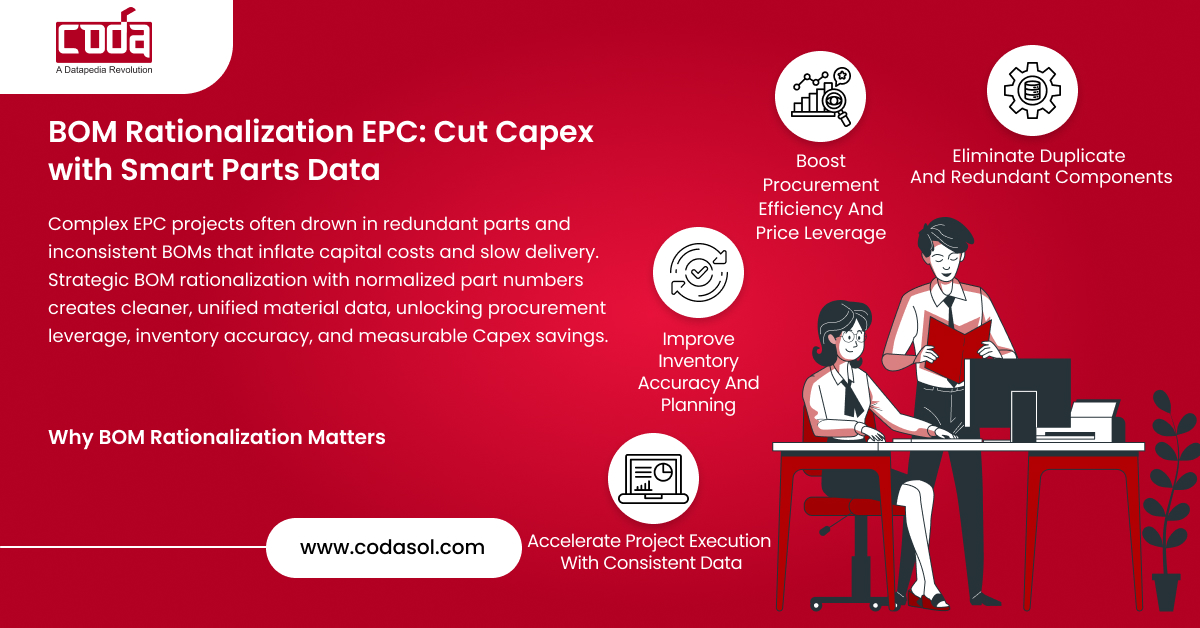
For EPC organizations, BOM rationalization is not just a data cleanup activity, it directly impacts Capex, procurement leverage, and delivery timelines.
1. Eliminate Redundancy Across Projects
Engineering, procurement, and project teams often maintain BOMs independently. Duplicate entries for the same components are common, inflating inventory and tying up Capex. CODASOL’s approach involves AI-assisted identification of duplicates and classification by functional similarity, enabling organizations to reduce unnecessary part counts and streamline their procurement processes.
2. Strengthen Procurement Negotiations
With a rationalized BOM, procurement teams can leverage consolidated demand across projects. CODASOL’s MDM platform provides real-time visibility into part usage across all projects, allowing procurement to negotiate better bulk pricing, reduce lead times, and cut costs.
3. Improve Inventory Accuracy
Accurate BOMs help forecast material needs better and prevent overstocking. CODASOL’s methodology includes automated validation and enrichment of BOM data, ensuring that teams order the right parts at the right time, reducing carrying costs, and freeing working capital.
4. Accelerate Project Delivery
Accurate BOMs reduce the risk of wrong orders and last-minute substitutions. CODASOL integrates BOM rationalization with ERP and PLM systems, ensuring that engineering changes propagate across all teams, preventing project delays and improving execution efficiency.
How BOM Rationalization Reduces Capex: A Strategic View
| Rationalization Strategy | Capex Impact | CODASOL Approach |
|---|---|---|
| Standardize Part Numbers | Lower procurement costs | AI-assisted part matching and normalization |
| Consolidate Redundant Components | Reduced inventory carrying costs | Duplicate detection and classification |
| Centralize BOM Data | Better planning & fewer errors | MDM-based single source of truth |
| Leverage Digital Tools | Faster decisions, lower risk | ERP/PLM integration with automated BOM updates |
| Supplier Consolidation & Volume Leverage | Lower unit purchase prices | Unified BOM visibility for strategic sourcing |
Digital Tools and Data Practices That Drive Rationalization
Master Data Management (MDM): The Foundation for BOM Integrity
At the core of BOM rationalization is Master Data Management (MDM), the system that governs how part, material, and equipment data is created, validated, and reused across the enterprise.
CODASOL’s MDM framework centralizes all material and part records into a single authoritative master repository, ensuring:
- Canonical part definitions with standardized attributes such as description, dimensions, material type, ratings, and manufacturer references
- Controlled part number generation aligned to classification rules, preventing duplicate creation at the source
- Attribute-level validation and enrichment, ensuring BOM items are technically complete before procurement or construction use
By enforcing governance rules at the master data level, CODASOL ensures that engineering BOMs, procurement catalogs, and maintenance BOMs all reference the same normalized part record. This eliminates downstream duplication, incorrect sourcing, and inconsistent reporting.
MDM transforms BOM rationalization from a one-time cleanup exercise into a continuous, governed process.
ERP and PLM Integration: Maintaining BOM Consistency Across the Lifecycle
BOM rationalization only delivers Capex value when normalized data flows seamlessly across enterprise systems. CODASOL integrates its rationalized BOM data with ERP, PLM, and EAM systems to maintain consistency throughout the asset lifecycle.
Key technical capabilities include:
- Bidirectional synchronization between MDM and ERP/PLM systems to keep BOMs aligned across engineering, procurement, and maintenance
- Version control and change propagation, ensuring engineering design changes automatically update downstream procurement and maintenance BOMs
- System-agnostic integration, supporting leading platforms such as SAP, Oracle, Maximo, and other EPC-specific tools
This integration prevents a common EPC problem: clean BOMs in engineering tools becoming fragmented once they reach procurement or maintenance systems. With CODASOL’s integration approach, one rationalized BOM structure governs all downstream processes, reducing rework and cost leakage.

See how BOM rationalization and governed master data help EPC teams negotiate better pricing and reduce material risk.
AI/ML-Assisted Matching: Scaling Rationalization Across Large BOM Volumes
Large EPC organizations often manage hundreds of thousands of part records, making manual rationalization slow and error-prone. CODASOL uses AI and machine learning techniques to scale BOM rationalization efficiently.
These capabilities include:
- Similarity and pattern recognition algorithms that identify near-duplicate parts based on technical attributes, descriptions, and manufacturer data
- Rule-based and probabilistic matching, enabling accurate consolidation of functionally identical components even when descriptions differ
- Automated normalization recommendations, suggesting standard part identifiers and classifications for engineer or data steward approval
By combining AI-assisted analysis with human governance, CODASOL achieves high-precision rationalization at enterprise scale. This allows EPC firms to continuously monitor BOM quality, detect new duplication early, and sustain long-term Capex savings.
BOM and PM Plan Creation in SAP
For EPC projects, accurate BOM creation in SAP is a critical step that links engineering, procurement, and maintenance. CODASOL’s approach ensures BOMs in SAP are standardized, accurate, and fully integrated, enabling project teams to reduce errors and optimize Capex.
Key BOM Creation Practices in SAP for EPC Projects
1. Standardized Part Data for BOM Rationalization in SAP
All materials and components in SAP are created using normalized part numbers and technical attributes, ensuring consistency and alignment with BOM rationalization efforts. CODASOL’s PROSOL direct integration with SAP store helps to maintain centralized, validated master data, reducing duplication, preventing miscommunication, and supporting accurate procurement planning across all projects.
2. Hierarchical BOM Structures
SAP BOMs are structured to reflect functional and physical assembly hierarchies, allowing engineering, procurement, and maintenance teams to interpret the data consistently. With PROSOL integration, hierarchical relationships and part dependencies are automatically mapped, improving project coordination and reducing errors.
3. Integration with PM Plans
CODASOL links BOMs with SAP Preventive Maintenance (PM) plans, assigning maintenance strategies, work centers, and schedules to assets. PROSOL ensures that any changes in BOMs are synchronized with PM plans, so preventive maintenance activities always align with material availability and project timelines, supporting operational efficiency.
4. Automated Updates & Governance
Engineering or procurement changes propagate automatically into SAP BOMs and PM plans. PROSOL’s MDM-driven governance reduces errors, enforces approval workflows, and maintains data integrity across all projects, ensuring that rationalized BOMs remain accurate over time.
5. Cost Optimization Insights from Rationalized SAP BOMs
By connecting BOMs with PM planning and SAP through PROSOL, organizations can track spare part usage, inventory requirements, and maintenance KPIs, generating actionable insights that drive Capex savings, better procurement decisions, and operational efficiency.

Step‑by‑Step Approach to Implement BOM Rationalization
A structured BOM rationalization program follows a clear, repeatable framework
- Data Cleanup & Audit
CODASOL applies AI-assisted auditing to identify duplicates and outdated entries. - Classification & Naming Rules
Standardization rules are implemented across all BOM items, including manufacturer part numbers (MPNs) and attributes. - Normalization & Consolidation
CODASOL merges equivalent parts under a single identifier, flagging obsolete components. - System Integration
BOM updates propagate across ERP/PLM systems to ensure cross-team consistency. - Governance & Controls
CODASOL’s governance framework enforces approval workflows and periodic audits, maintaining long-term accuracy.
BOM Rationalization Checklist: A Practical Guide for EPC Cost Control
Audit & Validate Data
- Perform a full audit of existing BOMs to identify duplicates, obsolete items, and inconsistencies
- Cross-check manufacturer part numbers (MPNs), supplier references, and technical specifications
- Leverage CODASOL’s AI-assisted data scanning to detect near-duplicate entries across systems
Standardize Naming & Classification
- Define canonical naming conventions across all BOMs
- Normalize part attributes: material, size, rating, functional category, supplier
- Apply classification rules aligned with industry standards (ISO, IEC, ANSI)
Normalize & Consolidate Parts
- Merge equivalent components under a single standardized part number
- Flag redundant or obsolete parts for removal or archival
- Use rule-based and probabilistic AI matching to identify functional duplicates that may have differing descriptions
System Integration & Version Control
- Sync normalized BOMs across ERP, PLM, and EAM systems
- Ensure bidirectional updates so engineering, procurement, and maintenance teams see consistent data
- Implement version tracking and change propagation to prevent outdated BOMs from entering production or procurement
Governance & Continuous Monitoring
- Establish approval workflows for BOM changes to maintain data integrity
- Conduct periodic audits of part numbers and BOM structures
- Implement real-time dashboards for BOM health and duplication trends
Optimization & Advanced Insights
- Continuously refine AI/ML matching models for accuracy as new parts are added
- Monitor inventory turnover, procurement efficiency, and Capex impact
- Leverage CODASOL’s MDM-driven insights to support procurement negotiation and operational planning

Ready to get immediate Capex savings through BOM rationalization?
Frequently Asked Questions
1. What does BOM rationalization mean?
BOM rationalization is the process of cleaning, standardizing, and optimizing the bill of materials to eliminate duplicates, improve accuracy, and reduce unnecessary costs. CODASOL provides proven frameworks to do this at scale.
2. How much Capex can be saved by normalizing part numbers?
Savings vary, but companies typically see 5–15% reductions in inventory costs and procurement inefficiencies. CODASOL’s AI-driven rationalization often accelerates ROI by identifying duplicate or obsolete items quickly.
3. Is part number normalization different from inventory optimization?
Yes. Normalization focuses on consistent identification, while inventory optimization uses that clean data to manage stock levels efficiently. CODASOL combines both for maximum operational impact.
4. Can BOM rationalization be automated?
Yes. CODASOL leverages MDM platforms and AI analytics to automate duplicate detection, part matching, and normalization, saving time and reducing errors.
Conclusion: Unlock Capex Savings Through BOM Rationalization
In complex EPC projects, inefficient BOMs and inconsistent part numbers quietly erode Capex, inflate inventory, and slow execution. BOM rationalization, supported by part number normalization and governed master data, changes how organizations control materials, procurement, and project costs.
By combining data audits, classification, AI-assisted consolidation, and ERP integration, EPC firms can eliminate redundancy, strengthen sourcing decisions, and accelerate project delivery. CODASOL’s MDM-driven approach ensures these gains are sustainable through continuous governance and insight-led optimization.
For EPC organizations operating at scale, BOM rationalization is no longer a cleanup exercise; it’s a strategic lever for long-term cost control and operational excellence.