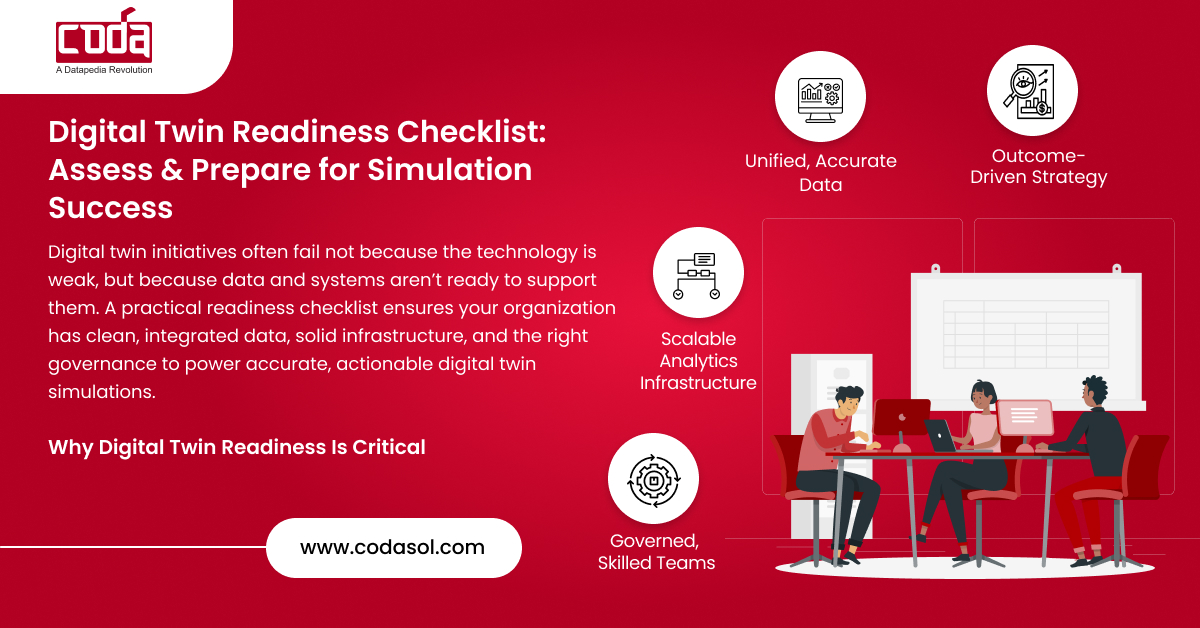
Assess your organization’s digital twin readiness with CODA’s practical checklist, 3D scanning, and simulation-ready data solutions.
Are You Digital Twin Ready? A Data Readiness Checklist That Makes Simulation Work
Digital Twin Readiness isn’t just a buzzword; it’s the difference between simulations that actually deliver insights and those that collect digital dust. For industrial leaders in Oil & Gas, Utilities, Manufacturing, Ports, and Infrastructure, the question isn’t whether you’ll adopt digital twins, it’s whether your organization is ready to turn data into actionable decisions.
This guide walks you through a practical checklist to assess your digital twin readiness, shows how CODA’s digital twin services help organizations bridge the readiness gap, and highlights the real business impact of getting it right.
What Does “Digital Twin Ready” Really Mean?
Think of a digital twin as a living, breathing version of your physical assets, but in the digital world. Digital twin readiness is simply making sure your data, systems, and teams are prepared to feed, run, and trust that twin.
It’s more than a 3D model or dashboard. A functional digital twin integrates live operational data, historical trends, and predictive analytics to help you make decisions that are faster, smarter, and risk-aware.
CODA’s digital twin platform ensures organizations have clean, structured, and validated data to power simulations that truly reflect reality. That way, when your twin says an asset might fail, you can act with confidence.
Why Your Data Needs to Be Ready for Digital Twins
Simulation is only as good as the data behind it. In industrial settings, this means:
Accuracy matters: Wrong data leads to wrong insights, which can cause downtime or misaligned maintenance decisions.
Consistency is key: Data must match across ERP, CMMS, and IoT systems.
Timeliness counts: The sooner your digital twin sees changes in real-time, the faster you can respond.
Traceability builds trust: Audit-ready data makes your simulations verifiable, reliable, and compliant.
Your Digital Twin Readiness Checklist: 5 Things to Check
CODA’s PROSOL platform creates a single source of truth by cleansing, enriching, and standardizing operational data. When combined with i-Stock, warehouse and spare parts data are kept accurate and traceable, essential for reliable digital twin simulations.
Decision-makers can measure readiness across five key dimensions. Use this checklist to identify gaps and focus on what matters most.
1. Business Strategy & Objectives
Clearly define what success looks like: Are you aiming to reduce downtime, optimize maintenance, or extend asset life?
Map KPIs such as maintenance cost savings, predictive maintenance accuracy, and operational efficiency.
Align digital twin initiatives with broader business strategy, so simulations are tied to real outcomes.
2. Data Quality & Integration
Ensure completeness: All critical assets have historical and operational data.
Verify accuracy: CODA’s 3D laser scanning captures precise geometry and asset details for reliable simulations.
Confirm integration: Your ERP, CMMS, IoT, and SCADA systems must feed data consistently into the digital twin platform.
Track traceability: Every change to data should be documented for audits and simulation validation.
Weak data breaks digital twins. CODA fixes asset accuracy, integration, and traceability before simulations go live.
Implement governance policies for master data, asset hierarchies, and version control.
Train teams in analytics, modeling, and digital twin monitoring to ensure adoption and reliability.
Digital Twin Readiness Framework: CODA Solutions and Business Outcomes
Dimension
CODA Solution
Key Outcome
Strategy & Objectives
Readiness assessment & KPI alignment
Clear goals, measurable ROI
Data & Integration
PROSOL & i-Stock
Accurate, traceable, reliable data
Infrastructure
CODA DT Platform
Scalable, real-time simulations
Analytics & Simulation
3D Laser Scanning & DT simulations
Optimized maintenance & uptime
Governance & Skills
Governance framework & training
Accountable teams, compliance ensured
How to Boost Your Digital Twin Readiness in 8 Practical Steps
Getting your organization ready for digital twin simulations isn’t about checking boxes; it’s about creating a step-by-step plan that turns data into action. Here’s how you can make readiness tangible:
Start with high-impact assets: Focus on equipment or systems where downtime or inefficiency has the biggest cost impact. Early wins build confidence and demonstrate value quickly.
Cleanse and standardize your data: Use CODA’s PROSOL platform to remove inconsistencies, duplicate records, and outdated information. Clean data is the foundation for trustworthy simulations.
Capture accurate geometry for critical assets: Leverage CODA’s 3D laser scanning services. Accurate 3D models reduce simulation errors and allow predictive maintenance without dismantling equipment.
Ensure spare parts and inventory accuracy: CODA’s i-Stock platform keeps warehouse and spare parts data reliable, so simulations that include replacements or maintenance planning are precise.
Validate models with small-scale simulations: Test a subset of assets before scaling. Iterative validation uncovers gaps in data, integration, or system behavior and reduces risk.
Integrate dashboards and feedback loops: Real-time dashboards allow teams to compare simulation outcomes with live operations, helping continuously improve accuracy and predictive capabilities.
Align teams and governance: Assign ownership for data and models, define approval workflows, and ensure cross-functional teams understand how to use insights. CODA helps implement clear governance and accountability.
Review, measure, and adjust: Track KPIs such as simulation accuracy, downtime reduction, and maintenance efficiency. Use lessons learned to refine asset coverage, data quality, and system integration.
By following these steps, you move from reactive asset management to predictive, data-driven decision-making, unlocking the true value of your digital twin.
This helps readers see that digital twin readiness isn’t theoretical; it’s already being adopted strategically across global EPC projects, especially in regions like India and the GCC.
How CODA Makes Digital Twins Work for Industrial Assets
CODA provides a full-spectrum solution to make digital twins work in the real world:
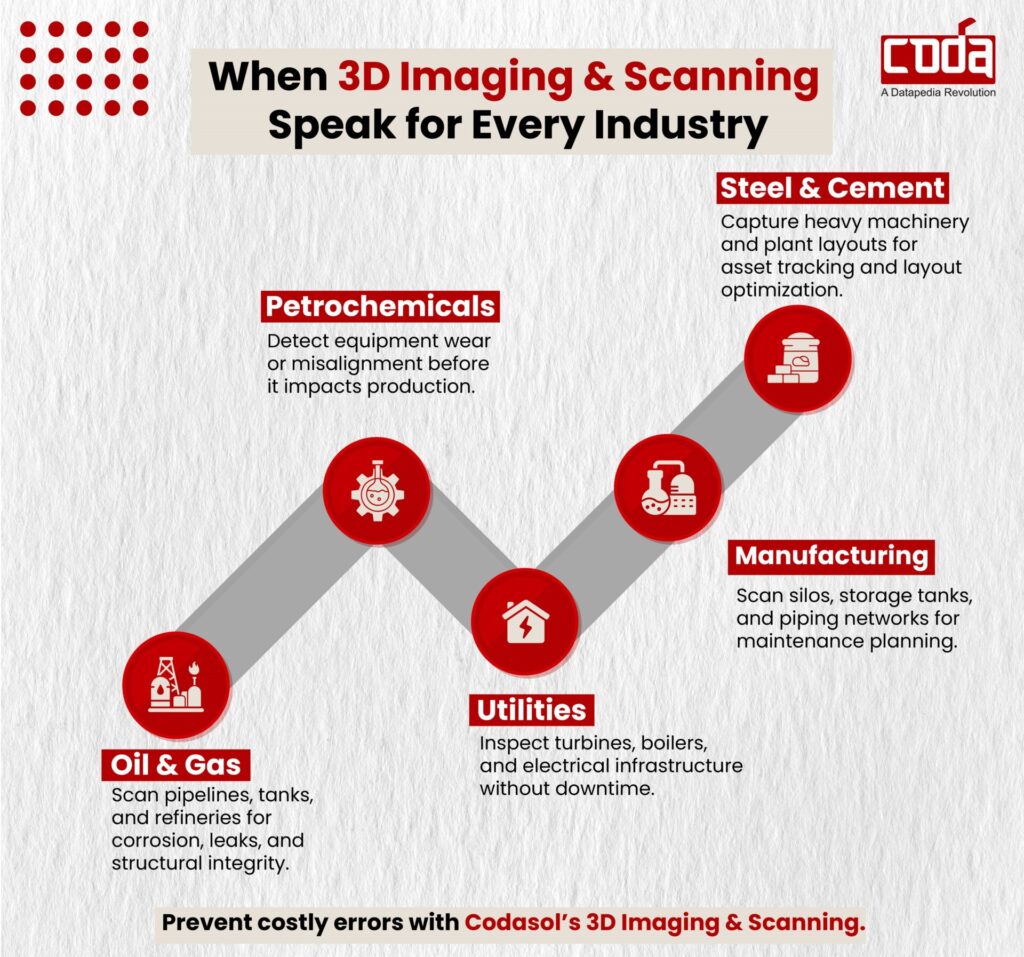
3D Scanning & Asset Modeling: Laser scanning generates engineering-ready 3D models for predictive analysis and reverse engineering. Visual documentation includes photos, videos, BOM, CAD, and PMI. Borescopy captures inaccessible areas.
Real-Time Simulation & Dashboards: CODA DT integrates live operational data, enabling plant simulations, predictive maintenance, and operational optimization.
Integration with Enterprise Systems: ERP, CMMS, and IoT platforms feed data seamlessly into the digital twin.
PROSOL & i-Stock Support: Clean master data and accurate inventory tracking ensure simulations are reliable and actionable.
Business Impact:
Reduced operational downtime
Optimized maintenance costs
Increased asset utilization and ROI
Enhanced compliance and audit readiness
Final Thoughts
Digital twin readiness isn’t about technology alone. It’s about trusting your data, connecting your systems, and empowering your teams to act on simulation insights with confidence.
Organizations that invest in readiness early see faster ROI, fewer failures, and stronger decision-making. Those that don’t often end up with impressive models that never deliver real value.
If you’re serious about making digital twins work, not just implementing them, it starts with getting your data ready.
Not sure where your organization stands on digital twin readiness?
Let’s have a practical conversation. CODA helps industrial enterprises assess readiness, close data gaps, and turn simulations into measurable business outcomes.
1: What is a digital twin readiness checklist? A structured assessment of data, systems, and teams to ensure simulations are accurate and actionable.
2: How do I assess data readiness for digital twin simulations? Check for completeness, accuracy, timeliness, integration, and governance. CODA’s PROSOL and i-Stock streamline the process.
3: What are common barriers to digital twin success? Poor data quality, fragmented systems, lack of governance, unclear business objectives, and limited team expertise.
4: How long does a digital twin readiness assessment take? Initial assessments for pilot projects usually take 4–8 weeks, depending on asset size and data maturity.