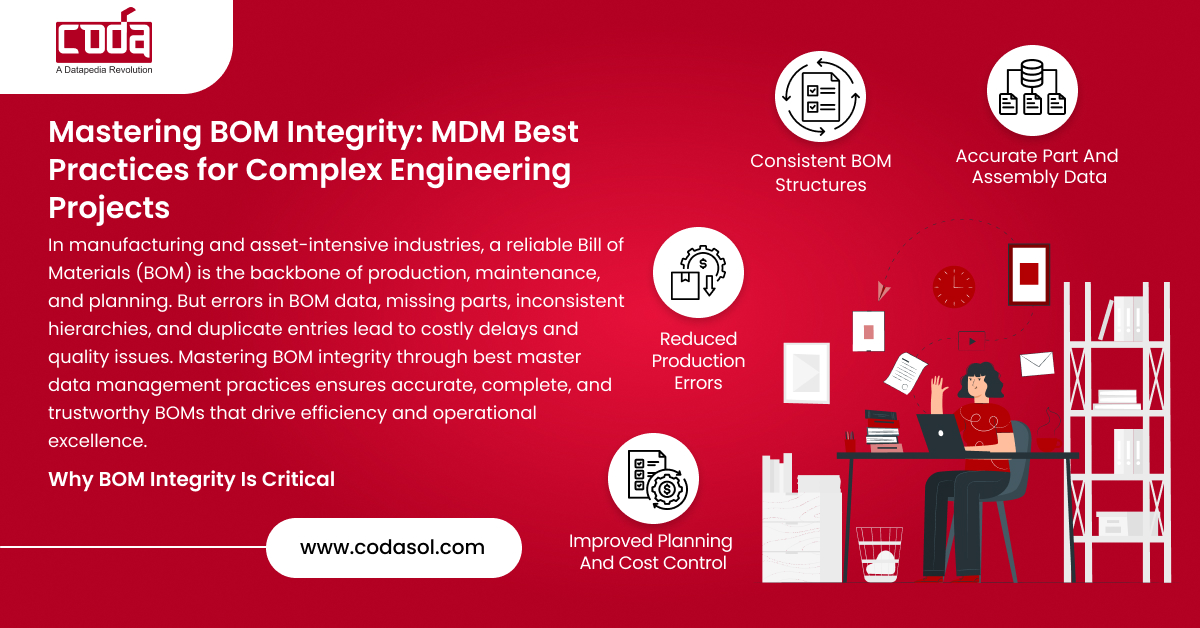
Mastering BOM Integrity: MDM Best Practices for Complex Engineering Projects
In complex engineering projects, even a single inaccurate item in a Bill of Materials can trigger cost overruns, procurement delays, or safety risks. For asset-intensive industries, BOM integrity isn’t just a data quality goal; it’s a core operational requirement. All it requires is a unified master data management approach rather than spreadsheets or disconnected systems to govern how engineering, procurement, and construction data flows across the organization.
This guide breaks down the best practices decision-makers use to safeguard BOM integrity, reduce project risk, and build a reliable digital foundation for engineering excellence.
Why BOM Integrity Matters in Engineering & Capital Projects
A Bill of Materials is the definitive list of parts, assemblies, materials, and specifications needed to build, install, operate, or maintain an asset. When BOMs are inaccurate, incomplete, or inconsistent, organizations face:
- Procurement delays due to wrong or duplicate part numbers
- Construction rework and unplanned shutdowns
- Conflicts between CAD, ERP, and vendor systems
- Inventory surpluses or material shortages
- Safety and compliance failures
- Budget escalation and schedule slippage
A utilities company once discovered 17 duplicates for the same pump model across its ERP and maintenance systems. Not only did this inflate inventory value by USD 1.2M, but it also caused incorrect issue slips during a maintenance turnaround. Such risks compound across long-cycle EPC or O&G projects where thousands of parts need precise tracking.
This is why industry leaders are shifting from manual BOM management to MDM-driven governance.
How MDM Strengthens BOM Integrity
MDM reinforces BOM integrity by centralizing, validating, and governing every detail tied to the Bill of Materials materials, equipment, parts, vendor attributes, and metadata. Once implemented, it becomes the single foundation that keeps engineering, procurement, construction, and maintenance aligned.
1. Establishing BOM Integrity Through a Single Source of Truth
Centralized Data Hub to Protect BOM Integrity
By consolidating materials, specifications, and engineering attributes into one governed repository, MDM removes conflicting versions and eliminates siloed data.
Impact on BOM Integrity:
- One authoritative dataset
- No manual reconciliation
- No engineering–procurement mismatches
2. Enhancing BOM Integrity with Controlled Versioning
Automated BOM Revision Management
MDM tracks every change, ensuring BOM revisions follow formal approvals and maintain alignment across design, construction, and maintenance.
How It Supports:
- Accurate cycle tracking
- Clear “as-designed” → “as-built” → “as-maintained” progression
- Complete audit visibility
3. Strengthening BOM Integrity Through Standardized Descriptions
Attribute Governance That Prevents BOM Misalignment
MDM enforces naming conventions, classification rules, and standardized attributes that ensure all components are consistently represented.
The Benefits:
- Clear, error-free descriptions
- Correct UOM, grade, size, and specifications
- Harmonized data across ERP and CAD systems
4. Preserving BOM Integrity with Automated Duplicate Detection
Intelligent Checks That Eliminate Redundancies
MDM identifies duplicate or near-duplicate items before they enter ERP systems and cleans up legacy data.
What This Means for BOM Integrity:
- Reduced inventory duplication
- Reliable procurement planning
- Removal of conflicting or redundant records
5. Improving BOM Integrity Through Systemwide Integration
SAP and CAD Alignment to Maintain Accurate BOMs
Through deep integration with SAP, Oracle, Maximo, and CAD/PLM platforms, MDM ensures that approved BOM updates flow consistently across all systems.
Supports BOM Integrity by:
- Preventing unauthorized BOM edits
- Ensuring synchronized updates
- Maintaining uniformity across engineering and procurement workflows
BOM Integrity Best Practices for Engineering Projects
1. Standardize Material Definitions and Naming Conventions
A unified standard ensures consistency across engineering drawings, vendor catalogs, purchase requests, and ERP data.
Key actions:
- Define mandatory attributes for each material class
- Establish part numbering rules
- Maintain units of measure consistency (M12 vs. 12mm, EA vs. EACH)
- Enforce attribute-driven descriptions
- Validate all vendor-supplied details through MDM
Where Prosol Helps
Prosol, Codasol’s MDM platform, uses rule-based material coding and a smart code generator to ensure every new item follows naming and classification standards, eliminating ambiguity and preventing uncontrolled variations.
2. Implement Centralized Data Governance With Clear Ownership
BOM integrity depends on disciplined governance:
- Define data owners for each class (Engineering, Maintenance, Procurement)
- Configure workflows for BOM change requests and approvals
- Enforce version control
- Maintain edit, review, and approval logs
Prosol Integration Advantage
With Prosol’s centralized governance engine, organizations can configure approval workflows that integrate directly with SAP. Engineers initiate changes, MDM teams validate them, and SAP receives only approved records, ensuring controlled updates.
3. Integrate Systems for Real-Time Sync to Protect BOM Integrity
Most BOM errors come from disconnected systems. Real-time integration ensures every team works from the same version.
What this enables:
- CAD/PLM BOMs sync instantly with ERP systems (SAP, Oracle, Maximo)
- Engineering, maintenance, and procurement view unified data
- Maintenance BOMs stay aligned with engineering revisions
- Vendor data enters with validation, not errors
Prosol Integration With SAP
Prosol connects natively with SAP through IDocs, BAPIs, and web services, ensuring:
- Clean material masters flow into SAP without manual entry
- Duplicate and attribute checks happen before creation
- BOM updates stay synchronized across engineering and procurement
This eliminates manual edits and prevents large-scale inconsistencies.

Get a rapid evaluation of your BOM quality, duplicates, and inconsistencies.
4. Cleanse and Enrich BOM Data Continuously
Even stable systems accumulate errors without ongoing care.
Key actions:
- Remove duplicates regularly
- Validate critical attributes
- Enrich with OEM/SKU metadata
- Normalize attribute formats
- Replace obsolete or superseded parts
Where Prosol Swift Helps
Prosol Swift, our customized data cleansing engine, accelerates BOM and material cleansing up to 5X faster than traditional methods, ideal for EPC projects, new plants, ERP migrations, and mergers.
Result: clean, accurate BOM data ready for enterprise use.
5. Strengthen Change Management and Lifecycle Traceability
Large engineering environments see constant revisions. Without traceability, BOM integrity breaks.
Best practices:
- Track revisions across design, procurement, construction, and O&M
- Maintain “as-designed,” “as-built,” and “as-maintained” BOMs
- Capture metadata for every change
- Preserve audit-ready logs for compliance
MDM enforces controlled workflows, ensuring every update is governed, consistent, and traceable.
Implementation Roadmap for Decision-Makers
A structured roadmap helps organizations move from fragmented BOM processes to a unified MDM-driven approach.
Step 1: Assess current BOM and material data quality
Identify duplicates, missing attributes, obsolete materials, and inconsistent classifications.
Step 2: Build data standards and governance policies
Define rules, roles, workflows, and classifications.
Step 3: Deploy an MDM platform (Prosol)
Configure the platform for your industry, plants, projects, ERP environment, and naming standards.
Step 4: Integrate with SAP, CAD, and procurement systems
Ensure seamless BOM and material data flow.
Step 5: Cleanse and enrich existing BOM data (Prosol Swift)
Migrate only validated and standardized data into target systems.
Step 6: Enable continuous audits and governance
Review BOM integrity periodically to maintain long-term reliability.
Get expert guidance and a clear path to cleaner, smarter, and fully aligned BOMs across your enterprise.