
RFID Asset Tracking for Airports: How to Build a Compliant Asset Register
Airports manage thousands of high-value, safety-critical assets every day. When asset data is outdated, fragmented, or manually maintained, compliance risks escalate quickly.
RFID asset tracking helps airports maintain a real-time, audit-ready asset register, without operational disruption or last-minute audit stress.
This guide explains how airports can build a compliant asset register using RFID, aligned with aviation regulations, asset management standards, and enterprise data governance best practices.
Why Airport Asset Registers Fail Compliance Audits
Most airport asset registers were never designed for today’s regulatory pressure or operational scale. Common failure points include:
- Asset records spread across spreadsheets, CMMS, and ERP systems
- Duplicate or inconsistent asset IDs
- Missing ownership, location, or lifecycle data
- Manual updates that introduce human error
- No real-time proof of asset existence during audits
When auditors ask for verification, teams scramble, putting safety, compliance, and operations at risk.
What Makes an Asset Register Compliant in Aviation
A compliant airport asset register must do more than list assets. It must prove control, traceability, and accuracy at any point in time.
Across standards such as ICAO, FAA expectations, and ISO 55000, a compliant asset register must ensure:
- Unique identification of every asset
- Clear asset ownership and accountability
- Lifecycle visibility from acquisition to retirement
- Location traceability, especially for airside assets
- Audit-ready documentation with minimal manual effort
This is where RFID asset tracking becomes critical.

Is your airport asset register truly audit-ready?
Airport Asset Compliance in GCC and India: What Decision-Makers Must Account For
While global frameworks like ISO 55000 and ICAO provide direction, airports in GCC and India operate under additional regulatory, audit, and governance expectations.
GCC: High-Compliance, High-Scale Environments
Airports across the UAE, Saudi Arabia, Qatar, Oman, and Bahrain operate under:
- Aviation authority audits
- ISO-aligned asset management mandates
- Smart airport and digital transformation initiatives
Compliance expectations typically emphasize:
- Real-time asset visibility
- Strong governance and access control
- Continuous audit readiness
- Alignment with national smart infrastructure programs
RFID-based asset registers meet these requirements without adding operational complexity.
Indian Airports: Regulatory & Public Accountability Focus
Indian airports must align with:
- AAI and DGCA oversight
- Government audits and statutory inspections
- Public-sector asset accountability and capitalization norms
In practice, this requires:
- Verifiable asset traceability
- Clear departmental ownership
- Documented maintenance and lifecycle history
- Accurate valuation for financial reporting
RFID asset tracking ensures asset data remains current, provable, and centrally governed.y ensuring asset data is current, verifiable, and centrally governed.
How RFID Asset Tracking Strengthens Airport Compliance
RFID asset tracking automates asset identification and monitoring using radio frequency tags. Unlike barcodes, RFID does not require line-of-sight scanning and can update asset status automatically.
For airports, RFID enables the following:
- Real-time asset location and movement tracking
- Automatic asset register updates
- Reduced data entry errors
- Faster audit verification
- Continuous compliance visibility
What Smart Asset Tracking Looks Like Across Asset-Heavy Industries
Airports face the same asset challenges as other asset-intensive industries, with too many critical assets spread across multiple locations, leaving little room for error. Oil & gas, utilities, manufacturing, and logistics all deal with similar risks: misplaced equipment, delayed maintenance, and compliance pressure.
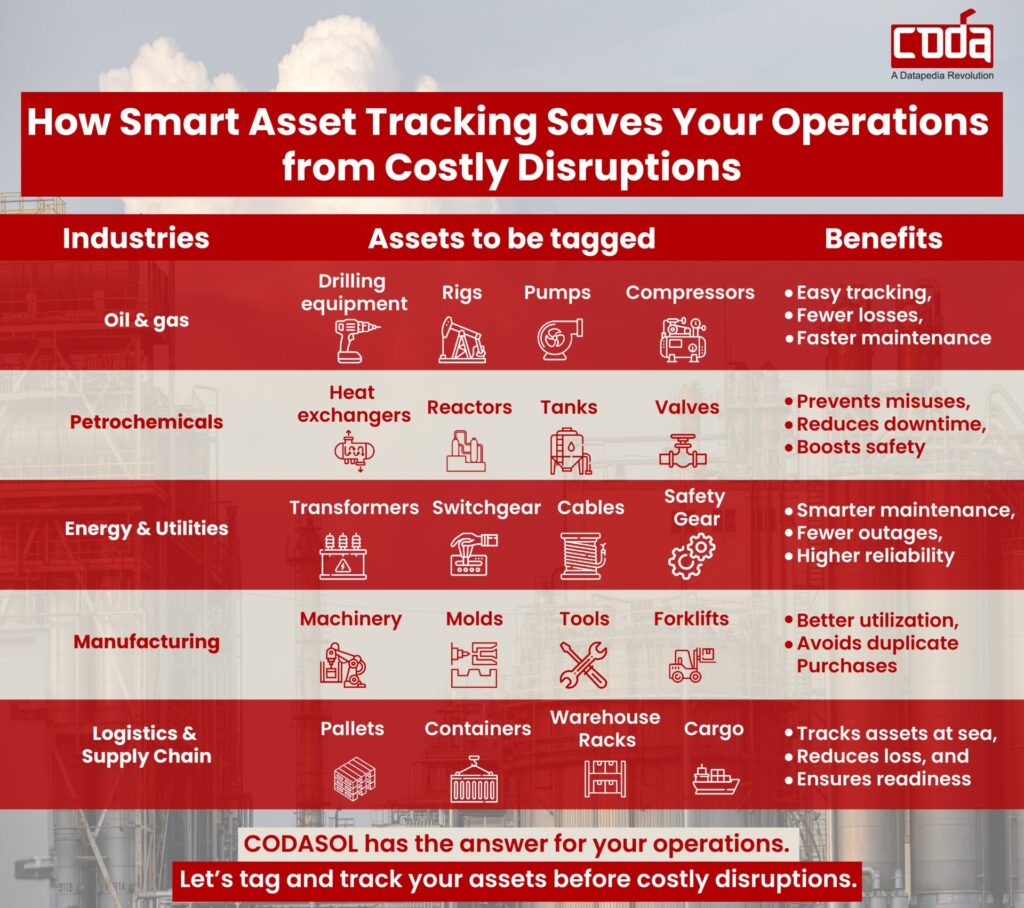
The image above shows how different industries tag and track their most critical assets, from drilling equipment and transformers to machinery, pallets, and cargo. Airports operate in a very similar environment, where missing or misidentified assets can delay operations, compromise safety, or trigger compliance issues.
What changes with RFID-based asset tracking is simple but powerful:
- Assets don’t get “lost in the system.”
- Maintenance teams don’t waste time searching.
- Operations stay prepared instead of reactive.
For airport leaders, this means fewer disruptions, better planning, and confidence during audits, because asset data is always current and verifiable.
Manual Asset Register vs RFID Asset Tracking
| Manual Asset Register | RFID Asset Tracking |
|---|---|
| Periodic manual updates | Real-time automated updates |
| High error risk | Consistent data accuracy |
| Audit-driven verification | Always audit-ready |
| Limited asset visibility | End-to-end asset traceability |
Step-by-Step: Building a Compliant RFID-Based Asset Register
Step 1: Identify Assets That Require Compliance Tracking
Not every asset needs RFID on day one. Airports should prioritize assets that impact safety, operations, and regulatory audits, such as
- Ground support equipment
- Airside vehicles and tools
- Security and surveillance systems
- Fire and safety equipment
- IT and communication infrastructure
Step 2: Standardize Asset Master Data Before RFID Deployment
RFID alone does not solve data quality issues. A compliant asset register depends on clean, standardized master data.
Each asset record should include:
- Standardized asset name and classification
- Unique asset ID
- Asset hierarchy (location, department, category)
- Critical attributes (make, model, serial number)
- Ownership and maintenance responsibility
This foundation ensures RFID data remains accurate and usable.
Step 3: Tag Assets Using the Right RFID Strategy
Airports typically use a mix of passive and active RFID, depending on asset value and movement frequency.
Key considerations:
- Tag type selection based on range and environment
- Secure tag placement to avoid damage or interference
- Asset-to-tag mapping in the central asset register
Step 4: Integrate RFID Data into a Central Asset Register
RFID data must flow into a governed asset register, not exist in isolation.
Best-practice integration includes:
- ERP or EAM system connectivity
- Automated validation rules
- Controlled updates via data governance workflows
This ensures asset data remains accurate across inspections, audits, and operational use.
How CODASOL Enables Compliant RFID Asset Tracking for Airports
RFID delivers visibility. CODASOL ensures that visibility is accurate, governed, and audit-ready.
Many airports implement RFID but struggle with inconsistent asset data, unclear ownership, and audit challenges. CODASOL addresses this by combining RFID tracking with structured master data and operational control through PROSOL and i-Stock.
PROSOL: The Asset Register Backbone
PROSOL acts as the central system of record for RFID-tagged assets, ensuring every asset is governed, standardized, and compliant.
Airports use PROSOL to:
- Maintain a single source of truth for asset master data
- Enforce naming, classification, and hierarchy standards
- Define ownership and approval workflows
- Align asset data with ISO 55000 and aviation compliance requirements
This ensures RFID updates strengthen the asset register instead of creating inconsistencies.
i-Stock: Real-Time RFID Inventory & Maintenance Tracking
i-Stock digitizes RFID-tagged tools, spares, and maintenance assets, giving operations teams real-time visibility and control.
With i-Stock, airports gain:
- Live tracking of asset availability and movement
- Accurate usage and issue/return records
- Reduced duplicate purchases and asset losses
- Faster maintenance response using verified asset data
From Tracking to Compliance
Together, PROSOL and i-Stock move airports from basic RFID tracking to governed, compliant asset management.
Architecture overview:
- RFID captures asset movement and status
- i-Stock manages operational usage and availability
- PROSOL governs and standardizes asset master data
- ERP/EAM systems execute maintenance, finance, and compliance
This layered approach keeps RFID data trusted, controlled, and audit-ready at scale.with governance, not trade-offs.
RFID-Based Asset Register Compliance Checklist
Use this checklist to validate whether your airport’s RFID asset register is audit-ready:
☑ All critical assets have unique RFID-linked IDs
☑ Asset data follows standard naming and classification rules
☑ Ownership and accountability are clearly defined
☑ Asset location is automatically updated
☑ Lifecycle events (repair, transfer, disposal) are tracked
☑ Asset data is centralized in a single source of truth
☑ Audit reports can be generated without manual reconciliation
If any box is unchecked, compliance gaps remain.

Compliance starts with trusted asset data.
See how airports govern RFID-enabled asset registers with MDM.
The Role of Data Governance in RFID Asset Tracking
RFID improves visibility, but data governance ensures trust.
A governed RFID asset register includes:
- Defined data stewards and approvers
- Controlled asset creation and change processes
- Periodic data quality checks
- Compliance reporting aligned with aviation standards
By combining RFID asset tracking with Master Data Management (MDM), airports maintain accuracy long after implementation.
Real-World Example: RFID-Driven Compliance Improvement
A large international airport managing thousands of airside assets faced repeated audit delays due to inconsistent asset records.
After implementing RFID asset tracking with governed master data:
- Asset verification time reduced by over 40%
- Duplicate asset records eliminated
- Audit preparation became continuous instead of event-driven
- Compliance reporting improved across departments
The result was better operational confidence and lower regulatory risk.
Final Wrap-Up
RFID asset tracking is no longer optional for modern airports. With growing regulatory scrutiny, complex operations, and asset-heavy environments, manual asset registers simply cannot keep up.
A compliant airport asset register requires:
- RFID-driven visibility
- Clean and governed asset master data
- Lifecycle tracking and ownership clarity
- Continuous audit readiness
When RFID is combined with strong data governance and platforms like PROSOL and i-Stock, airports gain more than compliance, they gain control, reliability, and operational resilience.
The result: fewer disruptions, faster audits, and confidence that every critical asset is exactly where it should be.
Ready to build a compliant, future-ready asset register for your airport?
Frequently Asked Questions
1. What is RFID asset tracking in airports?
RFID asset tracking uses radio frequency tags to automatically identify, locate, and update airport asset data in real time.
2. Is RFID compliant with aviation regulations?
Yes. When combined with proper governance and data standards, RFID supports compliance with ICAO, FAA, and ISO 55000 requirements.
3. What assets should airports track with RFID?
Airports typically prioritize airside equipment, safety assets, security systems, vehicles, and critical infrastructure.
4. How does RFID improve audit readiness?
RFID provides real-time asset verification, reducing manual checks and enabling instant audit reporting.
5. RFID vs barcode for airport asset tracking?
RFID enables automated, non-line-of-sight tracking, making it more suitable for large, dynamic airport environments.