
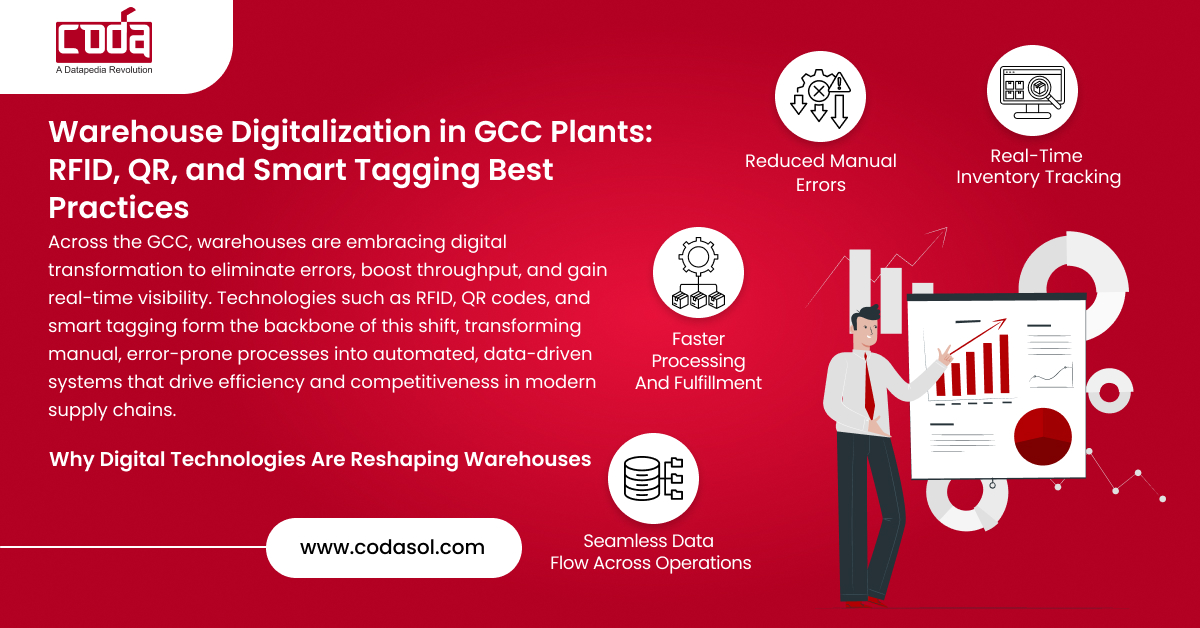
Warehouse Digitalization in GCC Plants: RFID, QR, and Smart Tagging Best Practices
Warehouse inefficiencies silently drain profits in asset-intensive industries. Inventory inaccuracies, lost spares, slow audits, and unplanned downtime are still common across GCC plants. Warehouse digitalization using RFID, QR, and smart tagging is no longer a future initiative; it’s now a proven operational necessity.
For decision-makers in Oil & Gas, Utilities, Manufacturing, EPC, and Ports, the real question is no longer whether to digitize but how to do it right with measurable ROI, system integration, and enterprise-grade data control.
This guide delivers a practical, decision-focused breakdown of warehouse digitalization best practices for GCC plants, including RFID vs. QR, hybrid smart tagging, and how a strong master data backbone turns physical tags into real business intelligence.
Why Warehouse Digitalization Is Now Mission-Critical for GCC Industries
Large industrial warehouses operate at a massive scale, often managing thousands to millions of SKUs, including high-value spares and safety-critical components, across long procurement cycles and under strict audit and compliance pressure. These operations run in harsh, metal-dense environments where heat, dust, and heavy equipment are the norm.
Yet, many warehouses still depend on:
- Manual barcode scans
- Spreadsheet-based tracking
- Periodic physical audits
- Disconnected ERP and inventory records
This leads directly to stock mismatches, spare part unavailability, excess inventory, maintenance delays, and locked capital in dead stock. Warehouse digitalization eliminates these blind spots through real-time inventory visibility, automated tracking, and data-driven decision control, restoring accuracy, speed, and operational confidence.
Understanding the Core Technologies: RFID, QR & Smart Tagging
1. RFID (Radio Frequency Identification)
RFID uses radio waves to automatically identify and track tags attached to items. It enables:
- Bulk scanning without line-of-sight
- Real-time movement tracking
- Automated receiving, picking, and dispatch
- Faster cycle counts and audits
Best suited for: Pallets, high-velocity inventory, returnable assets, and critical spares in high-volume operations.
2. QR Codes
QR codes are cost-effective, camera-readable tags that store structured information.
Strengths:
- Very low implementation cost
- Easy to deploy
- Good for manual operations and field use
- Works without specialized RFID hardware
Limitations:
- Requires line-of-sight
- One-by-one scanning
- Not ideal for automation-heavy environments
3. Smart Tagging
Smart tagging combines:
- RFID for automation
- QR for human interaction
This hybrid model ensures operational resilience. If RFID readers are unavailable, teams can still scan assets using mobile devices.
This is where solutions such as i-Stock Smart Asset Tagging play a critical role by:
- Digitally identifying assets, MRO spares, tools, and returnable items
- Linking physical tags directly with enterprise inventory systems
- Enabling real-time traceability across warehouses, yards, and maintenance locations
RFID vs QR vs Smart Tagging: Quick Comparison
| Feature | RFID | QR Code | Smart Tagging |
|---|---|---|---|
| Line of sight needed | No need; reads through objects | Needs direct scan | RFID: no, QR: yes |
| Read speed | Reads many items at once | One item at a time | Bulk via RFID + manual via QR |
| Automation readiness | High | Low | Very high |
| Cost | Medium–High | Low | Balanced/optimized |
| Harsh environment support | High | Medium | High |
| Ideal for GCC plants | Great for large automated warehouses | Better for small/manual stores | Best for flexibility & scale |

Not sure if RFID or QR or both fit your plant?
Key Benefits of Warehouse Digitalization for Asset-Intensive Enterprises
Warehouse digitalization is more than technology it’s a strategic advantage that directly impacts operational efficiency, cost control, and asset reliability. By integrating RFID, QR, and smart tagging, enterprises can transform inventory management from a reactive process into a proactive, data-driven operation.
Real-Time Inventory Visibility
Digitally tracked warehouses provide instant insight into inventory levels, locations, and movements. This ensures that production and maintenance teams always know what stock is available, what is in transit, and what is under maintenance, reducing emergency procurement and operational delays.
Improved Inventory Accuracy Through Warehouse Digitalization
Manual tracking errors and duplicate records are common in traditional systems. Warehouse digitalization ensures reliable item counts, eliminates phantom inventory, and supports audit-ready processes, helping organizations achieve accuracy levels above 98%.
Faster Receiving, Picking, and Dispatch
Automated workflows accelerate warehouse operations:
- Reduce dock processing time
- Minimize human errors
- Speed up audits and cycle counts
This leads to smoother operations and higher throughput with the same workforce.
Cost and Space Efficiency from Warehouse Digitalization
By reducing manual labor and improving tracking, warehouse digitalization lowers operational costs and frees staff for higher-value tasks. Additionally, real-time data helps optimize storage layouts, implement dynamic slotting, and retrieve materials quickly, maximizing warehouse space and utilization.
Where PROSOL Strengthens Warehouse Digitalization
Many warehouse digitalization programs fail not because of sensors or tags, but because the underlying data is unreliable. If material masters are duplicated, wrongly classified, or inaccurately described, even the best RFID system produces misleading results.
This is where PROSOL becomes critical.
PROSOL acts as the master data backbone that ensures every RFID and QR tag is linked to:
- A single, trusted material master
- Standardized naming conventions
- Correct units of measure
- Governed classification structures
With PROSOL in place, organizations achieve the following:
- ERP-synchronized tagging
- Clean MRO master data
- Reduced duplicate SKUs
- Reliable inventory planning
Without enterprise MDM, warehouse digitalization remains fragmented. With PROSOL, it becomes scalable, auditable, and decision-ready.

Get measurable ROI with warehouse digitalization
i-Stock Smart Asset Tagging: Turning Physical Assets into Digital Intelligence
While PROSOL governs the data layer, i-Stock operates at the execution level, connecting physical assets to digital inventory systems in real time.
i-Stock enables:
- RFID + QR hybrid tagging
- Smart labeling of spares, tools, safety equipment, and returnable assets
- Real-time asset movement tracking
- Automated check-in and check-out
- Complete asset usage history
High-impact use cases include:
- Oil & Gas spare parts tracking
- EPC project inventory control
- Utilities maintenance stores
- Marine and port equipment tracking
- Aviation ground support equipment monitoring
Together, PROSOL + i-Stock create a closed-loop digital warehouse ecosystem from master data to physical tracking to predictive analytics.
Warehouse Digitalization ROI: Key Metrics for Decision-Makers
| KPI | Traditional Warehouse | Digital Warehouse |
|---|---|---|
| Inventory accuracy | Moderate (85–90%) | Very high (98–99%) |
| Cycle count duration | Slow (days) | Fast (hours) |
| Emergency procurement | Frequent | Minimal |
| Maintenance delays | Common | Significantly reduced |
| Dead stock value | High | Controlled |
Why Warehouse Digitalization Is Especially Critical for GCC Enterprises
GCC industries face unique operational challenges: heavy reliance on imported spares, long international lead times, costly downtime during shutdowns, massive asset portfolios, and increasing ESG and audit requirements.
Warehouse digitalization directly addresses these pressures by boosting:
- Operational resilience: keep critical operations running without delays
- Asset availability: ensure spares and equipment are always on hand
- Supply chain transparency: track every movement in real time
- Predictive maintenance readiness: plan maintenance before issues occur
By digitizing warehouses, GCC enterprises transform these challenges into measurable operational advantages.
A Practical 5-Step Roadmap to Start Warehouse Digitalization
- Operational Visibility Assessment
Identify stock mismatches, search delays, and downtime triggers. - Master Data Cleanup
Standardize MRO and inventory data using PROSOL. - Smart Tagging Deployment
Implement i-Stock with RFID and QR tagging. - Enterprise Integration
Connect to ERP, WMS, and maintenance systems. - Performance Monitoring & Scale-Up
Track KPIs and expand plant by plant.
Frequently Asked Questions
1. Is RFID better than QR for industrial warehouses?
RFID is superior for automation and bulk tracking. QR works well for manual verification. Smart tagging uses both together.
2. What is the ROI of warehouse digitalization?
Most large plants achieve ROI within 12–24 months through labor savings, reduced emergency procurement, and improved asset availability.
3. Does RFID work in metal-heavy environments?
Yes, when metal-mount industrial-grade RFID tags are used.
4. Why is master data important for RFID success?
Because inaccurate material masters make even the best RFID system unreliable.
5. Which industries benefit the most?
Oil & Gas, Utilities, Manufacturing, EPC, Ports, Aviation, Defense, Healthcare, and Mining.
Final Thoughts: Digital Warehousing Is Now a Business Imperative
Warehouse digitalization is no longer about tracking stock; it is about controlling operational risk, maximizing asset uptime, and enabling real-time decision intelligence.
When smart tagging (i-Stock) is built on trusted master data (PROSOL), warehouses evolve into intelligent operational hubs that support predictive maintenance, cost governance, and enterprise-level planning. And this is how modern GCC plants future-proof their operations.
Ready to modernize your warehouse with smart tagging and trusted data?